Multiple choice
Students select one best answer from several options.
Example After reading a short paragraph about weather tools, a student picks the sentence that best states the main idea.
TEA resource
Verified Texas Education Agency updates on the Student Success Tool, STAAR/SST reading language arts item types, statewide data, and Teach BIG classroom resources.
Purpose
Stay informed. Feel included. Find what you need.
Our purpose is to keep Texas teachers informed, connected, and confident by making important assessment information easier to find, easier to understand, and easier to put into perspective.
You should not have to attend every meeting, search through dozens of webpages, or piece together scattered announcements to feel informed about the assessments that affect your students. You deserve a dependable place to begin, one that respects your time, connects you with original sources, and helps you understand what deserves your attention.
At Teach BIG, we do the legwork so you can spend less time searching for information and more time using it thoughtfully.
As Texas prepares for the transition from STAAR to the Student Success Tool (SST), our goal is to help teachers follow the changes without losing sight of what matters most: meaningful instruction and student growth.
Newest TEA correspondence first. Teach BIG updates this list as official SST guidance is published.
TEA posted SST reporting prototype examples, expanded the HB 8 FAQ, and confirmed a required SST stand alone field test February 1 to 5, 2027. Alternative BOY and MOY assessment approvals are expected by October 2026.
The redesigned calendar lists BOY, MOY, and EOY windows for SST, replaces STAAR beginning 2027 to 2028, and notes SST Alternate (formerly STAAR Alternate 2) and updated reporting time frames under HB 8.
Source: School Year 2027-28 Student Assessment Testing Calendar (TEA)
HB 8 (89th Legislature, 2nd Called Session, 2025) replaces STAAR with the Student Success Tool (SST) in 2027 to 2028, adds BOY, MOY, and EOY assessments for grades 3 to 8 and Spanish 3 to 5, and eliminates the English II EOC beginning 2027 to 2028.
Source: Overview of House Bill 8 (TEA)
2026 to 2027 is the final school year districts may administer optional STAAR Interim Assessments. SST with BOY and MOY replaces interim assessments in 2027 to 2028.
Source: STAAR Interim Assessments (TEA)
These windows change how you plan the year. Our seminars show where each one belongs in daily reading and writing instruction. See the workshops
Redesigned STAAR/SST reading language arts tests include technology enhanced formats. Each card links to TEA documentation.
Students select one best answer from several options.
Example After reading a short paragraph about weather tools, a student picks the sentence that best states the main idea.
TEA resourceTwo or more linked questions share context; later parts may depend on earlier answers.
Example Part A asks which detail supports an inference; Part B asks the student to explain how that detail supports the answer.
TEA resourceStudents choose more than one correct option from a list.
Example Select all phrases from the passage that show the character feels determined, not just one answer.
TEA resourceStudents choose the correct word or phrase inside a sentence or paragraph.
Example A sentence about revising includes drop down menus where the student picks stronger verbs or transitions.
TEA resourceStudents click or tap portions of a passage to show evidence or correct understanding.
Example Highlight the two sentences in the article that best prove the author values conservation.
TEA resourceStudents type a brief response, such as a word, phrase, or short answer.
Example Type the vocabulary word that completes the analogy using context from the stanza.
TEA resourceBrief written response scored with a prompt specific rubric. On RLA tests, reading SCRs use a 0 to 2 point scale and writing SCRs use a 0 to 1 point scale.
Example In two or three sentences, explain how the diagram supports the section heading about the water cycle.
TEA resourceEssay style response to a reading selection in informational or argumentative mode. Scored on a five point rubric for organization and development of ideas and conventions.
Example Write a multi paragraph response explaining how the author develops the central idea, using evidence from the passage.
TEA resourceSeeing the item type is the first step. Seminars show how those same formats show up in student work and how to practice them before test day. See the workshops
Real sentences from TEA's released 5/5 ECR papers, Grades 3 to 8 and English I and II.
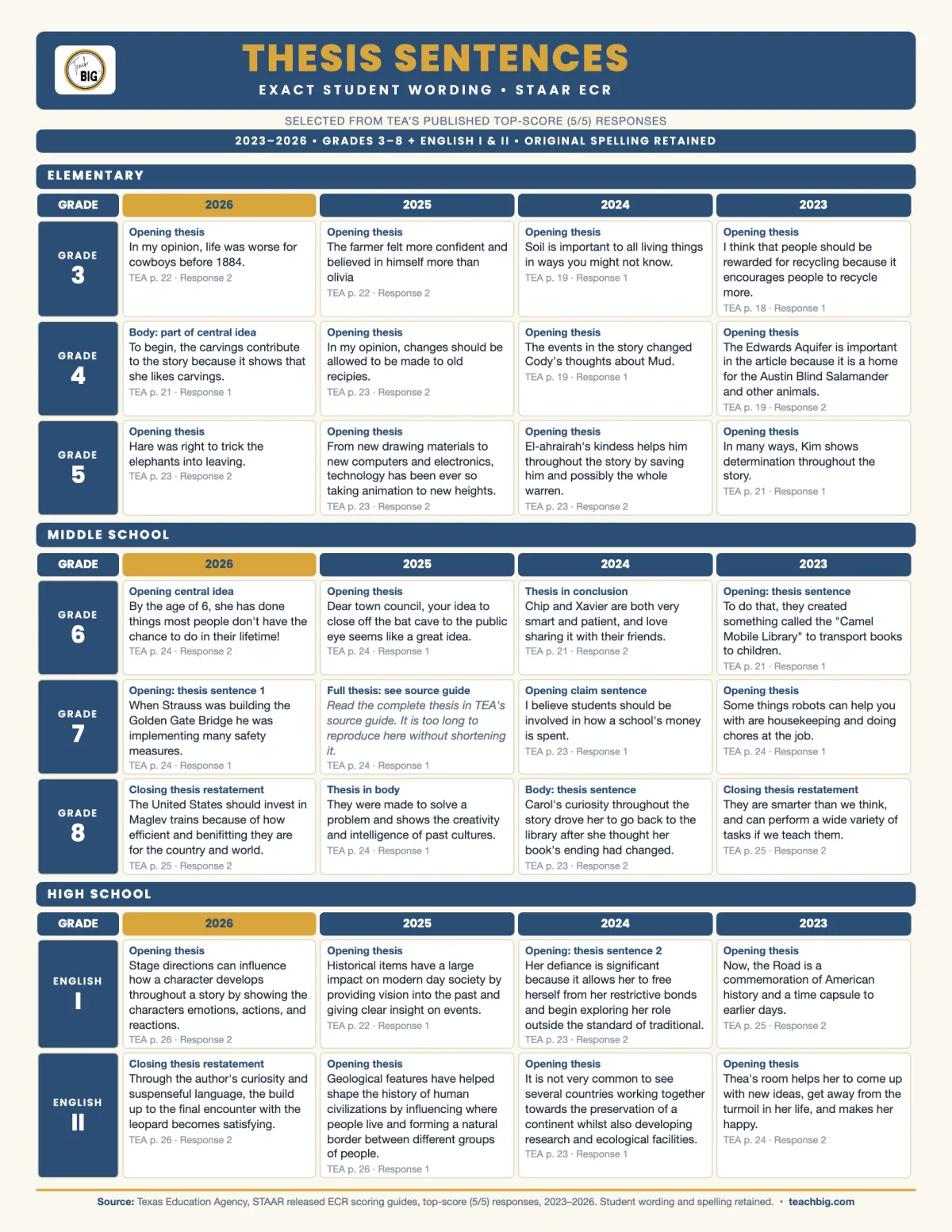
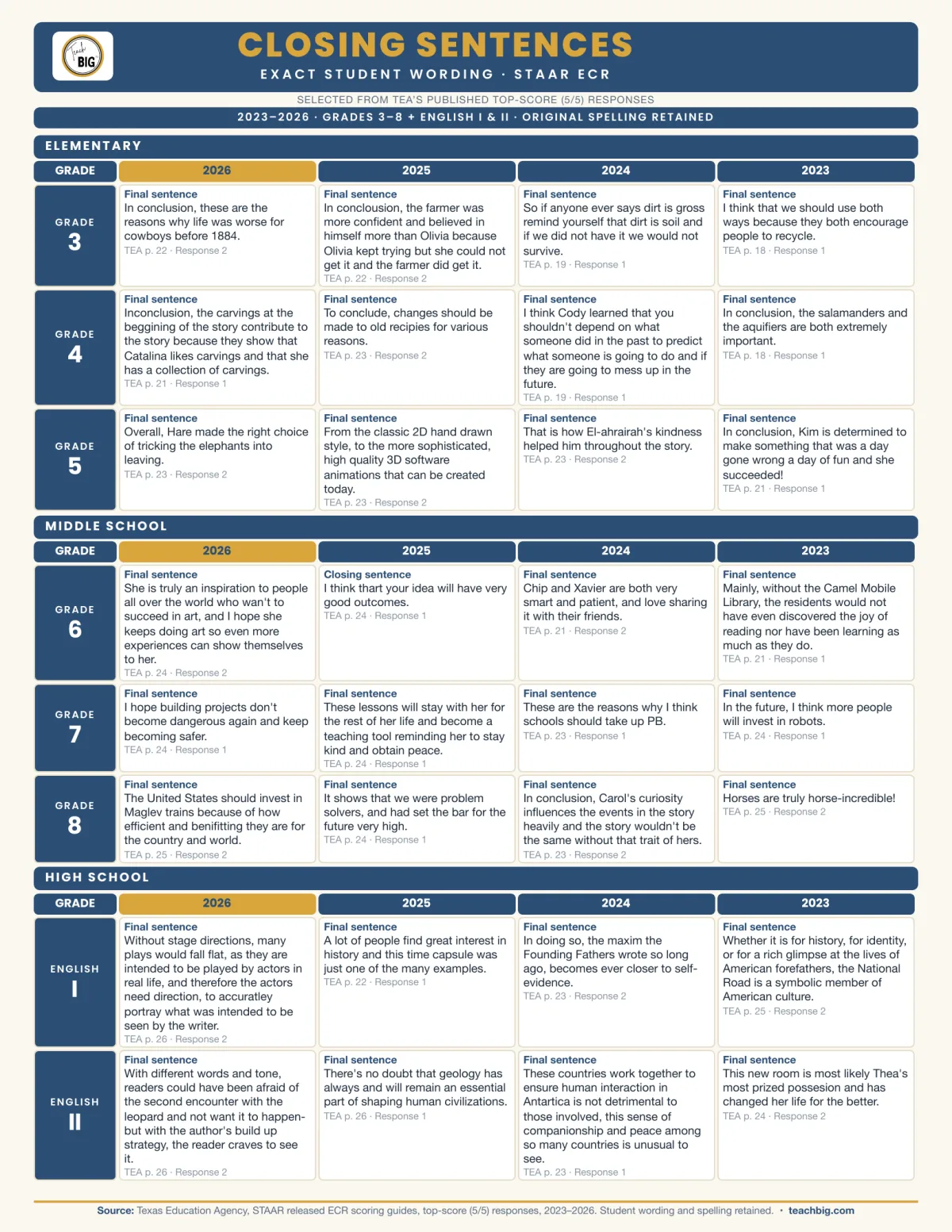
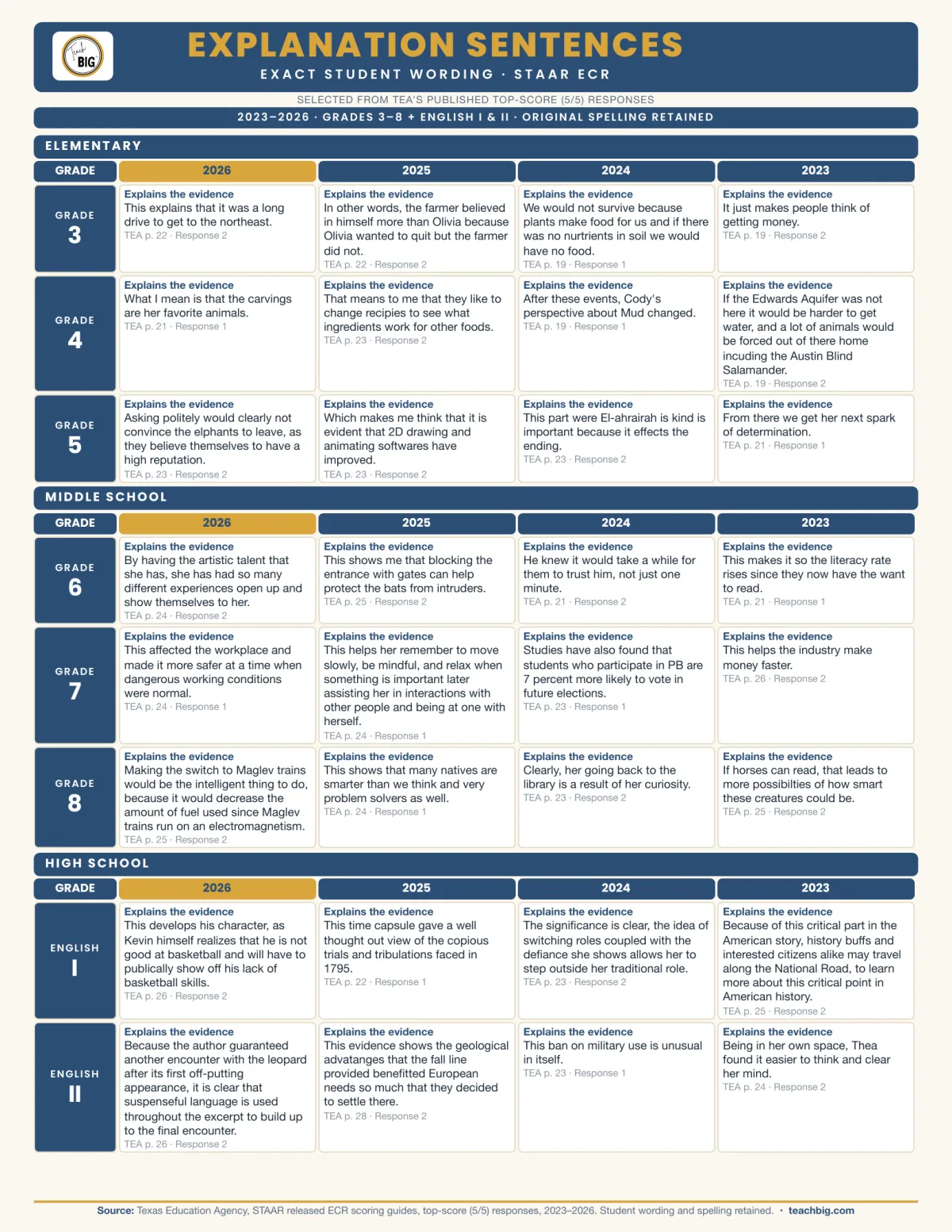
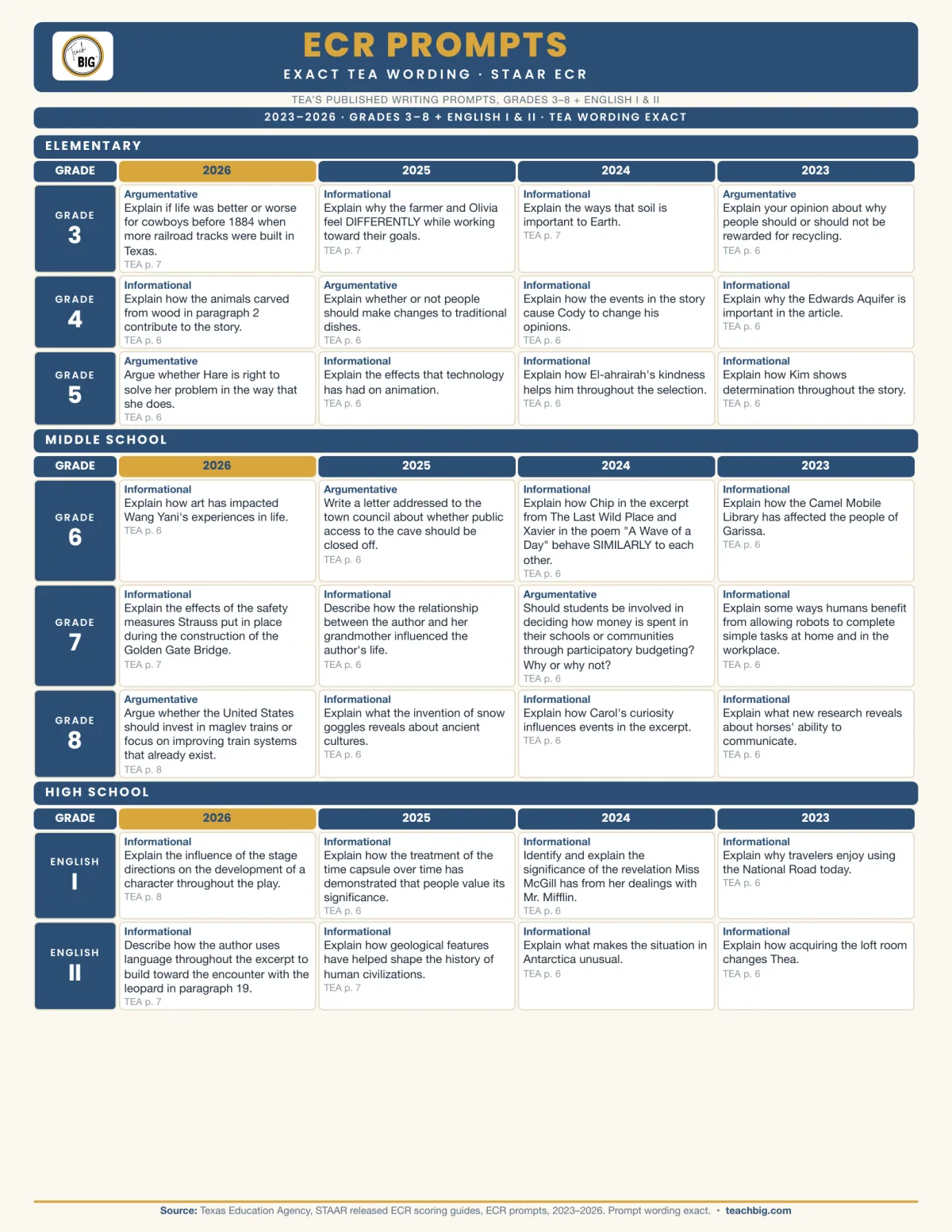
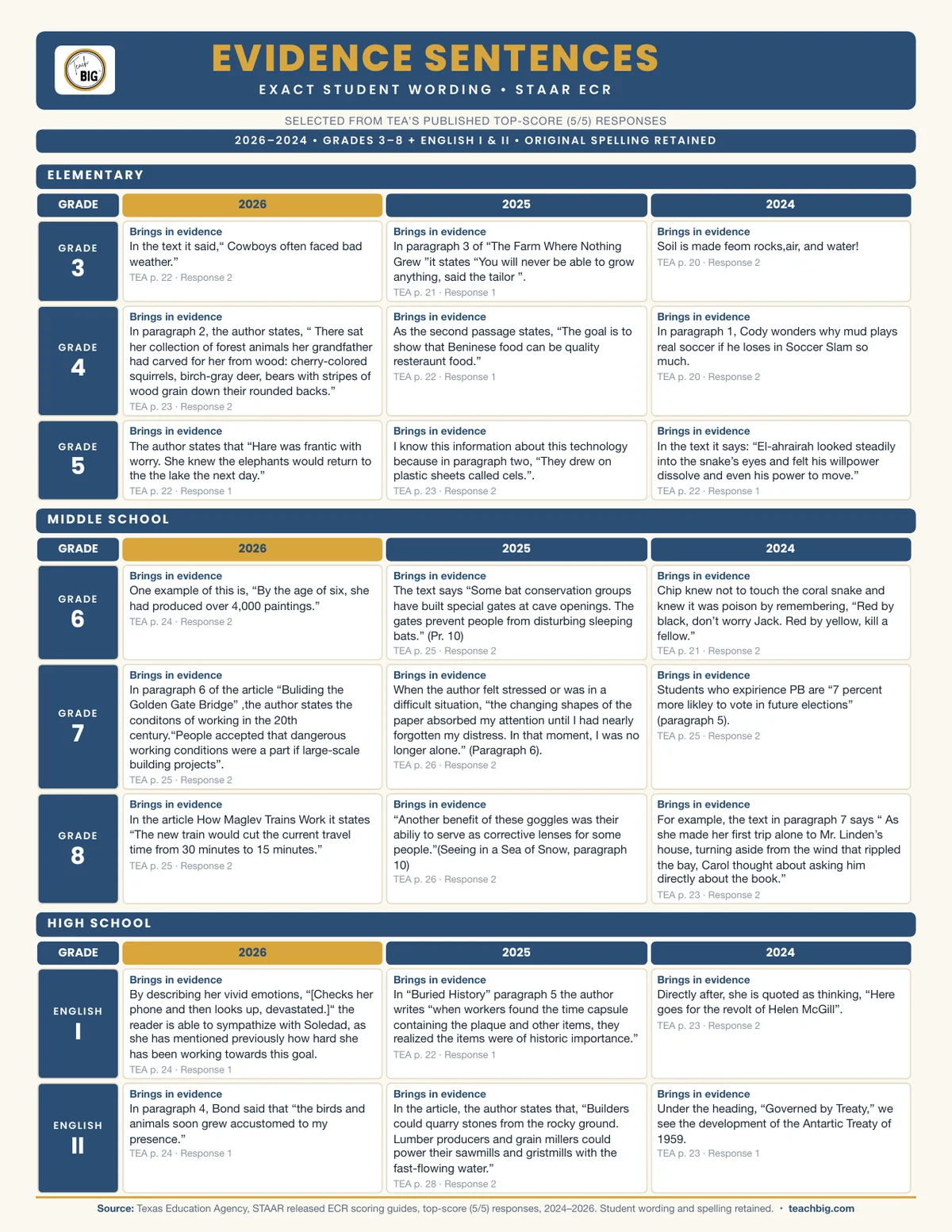
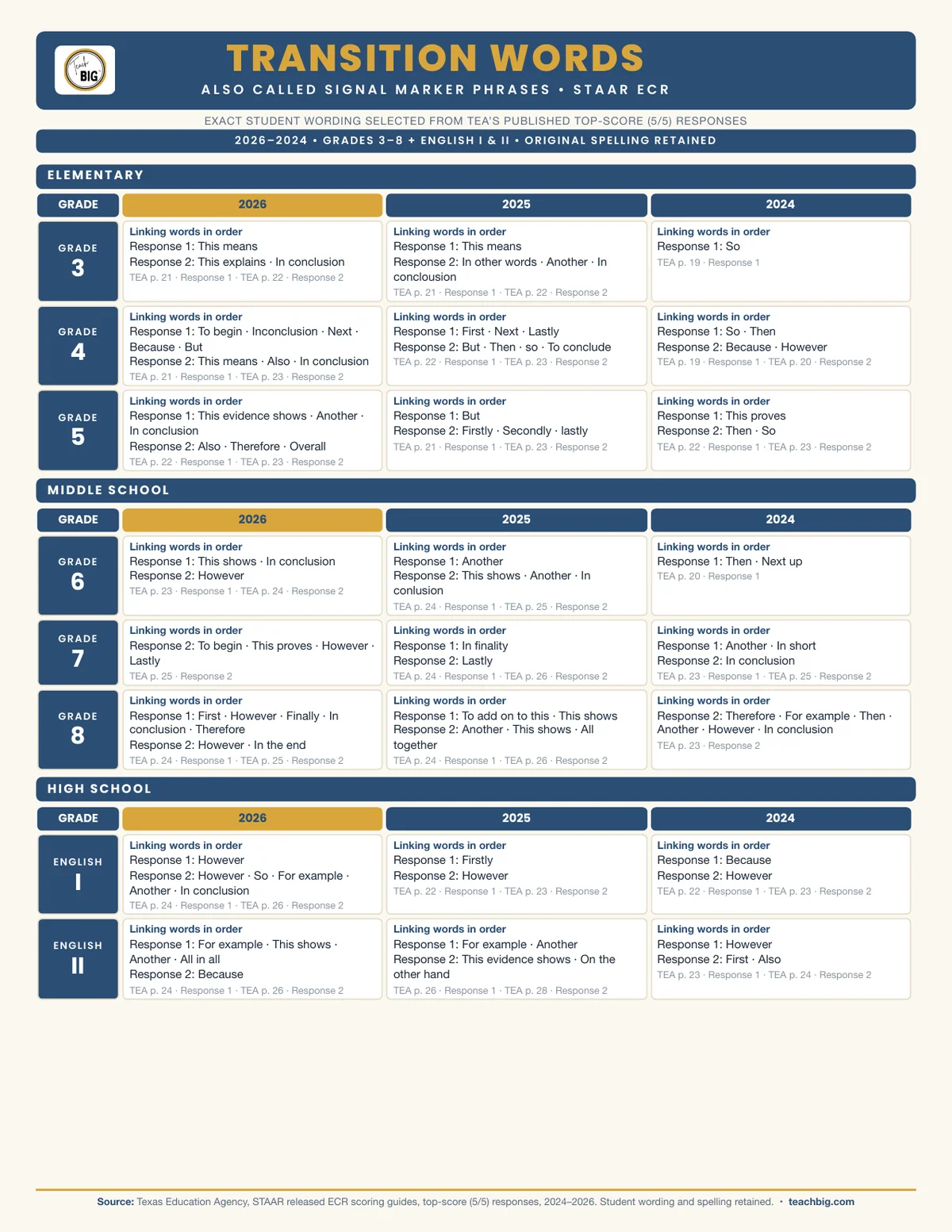
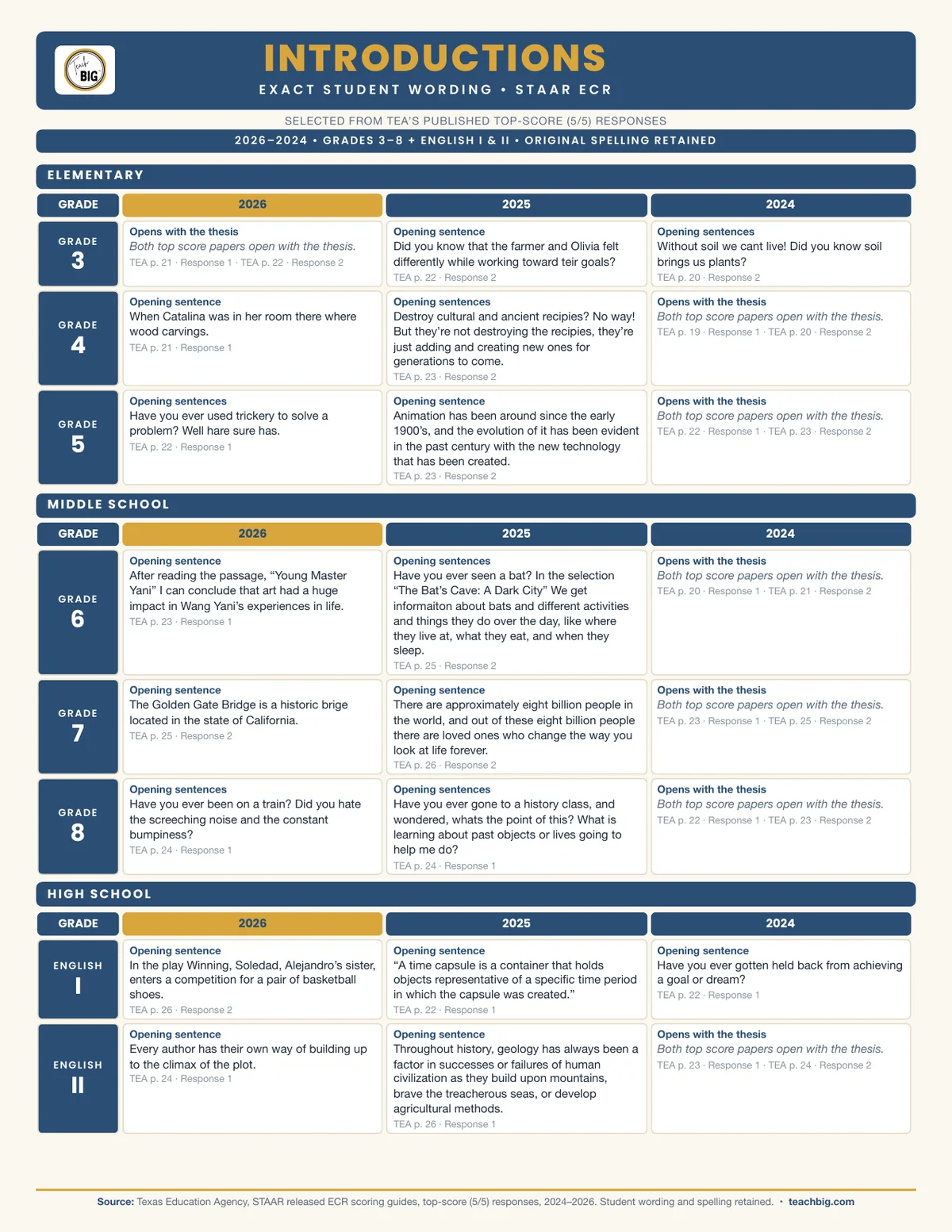
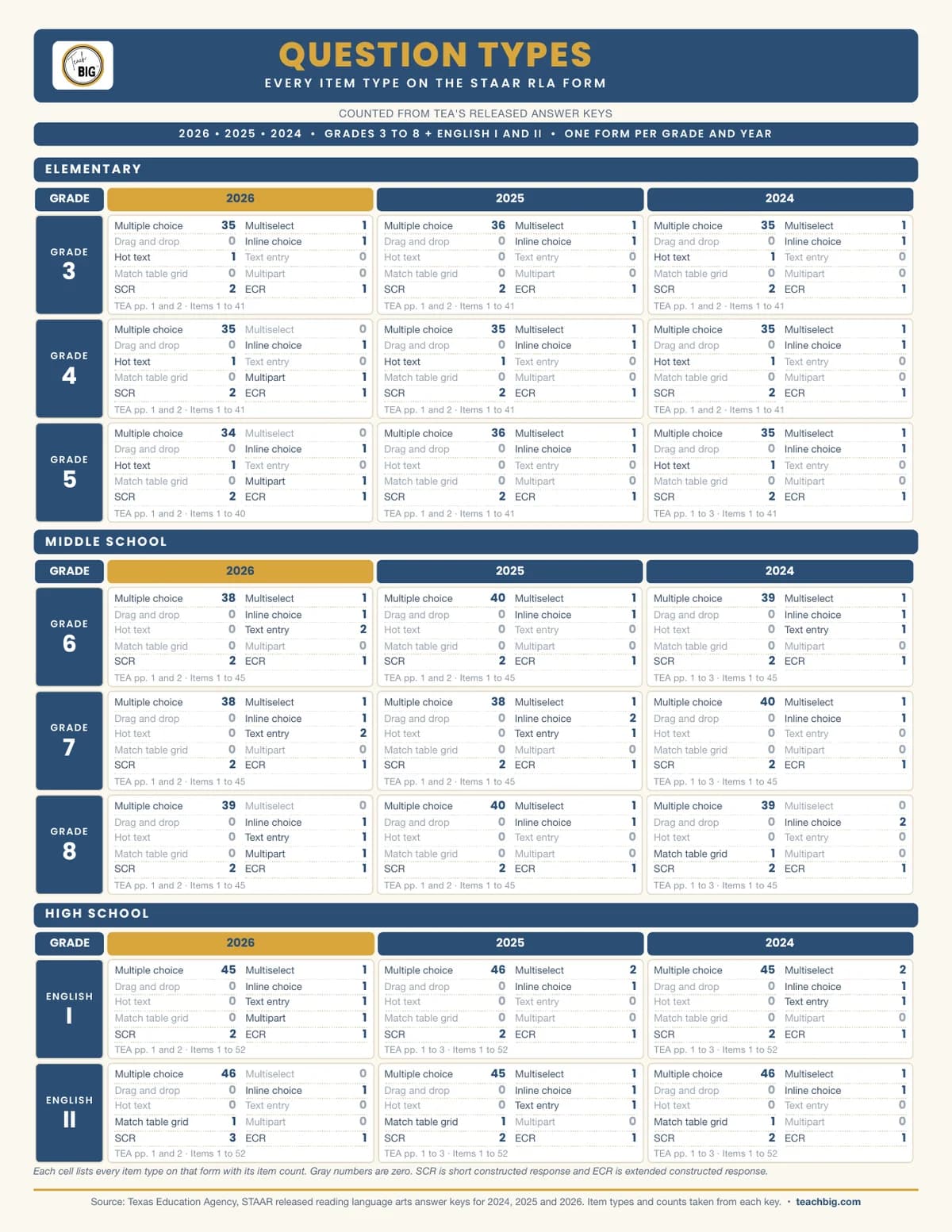
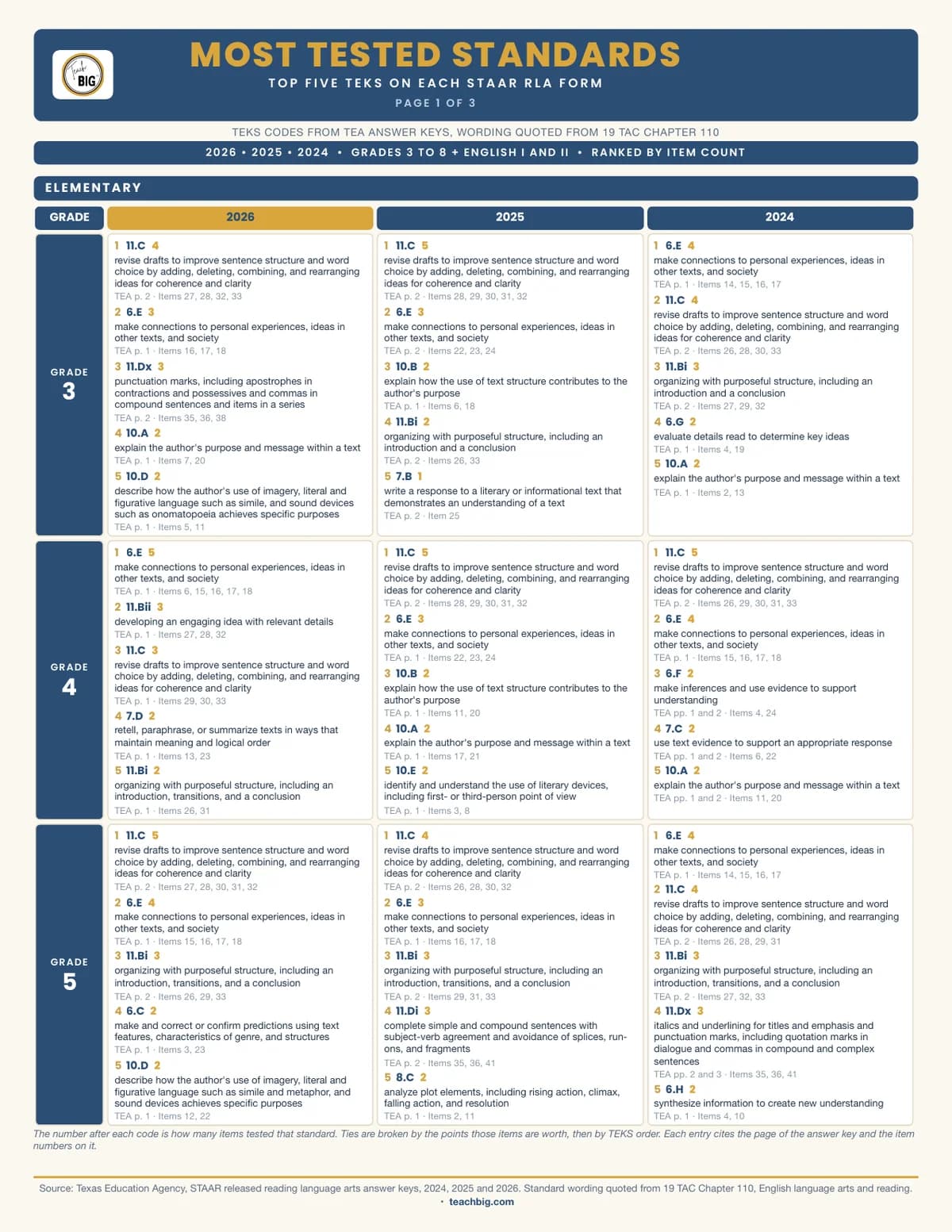
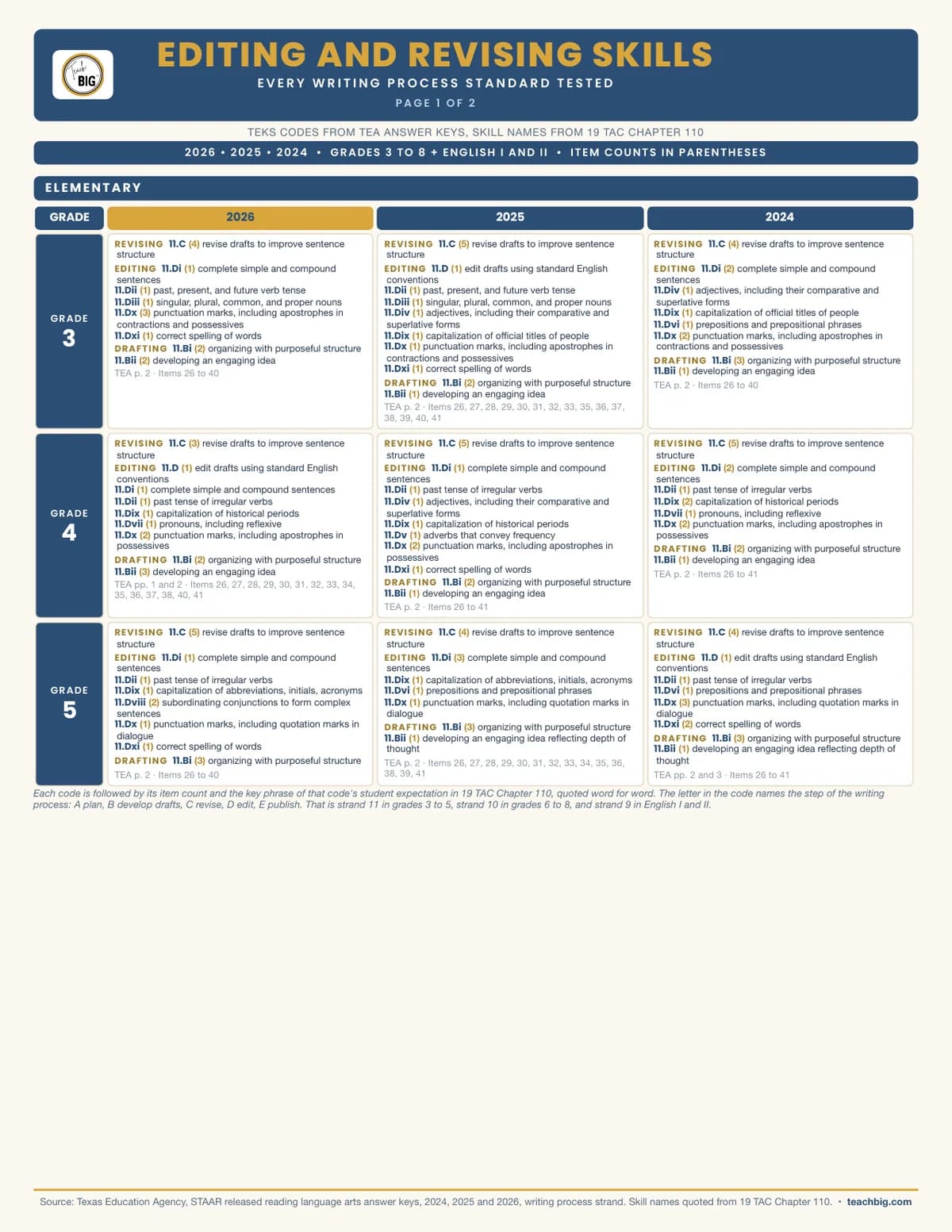
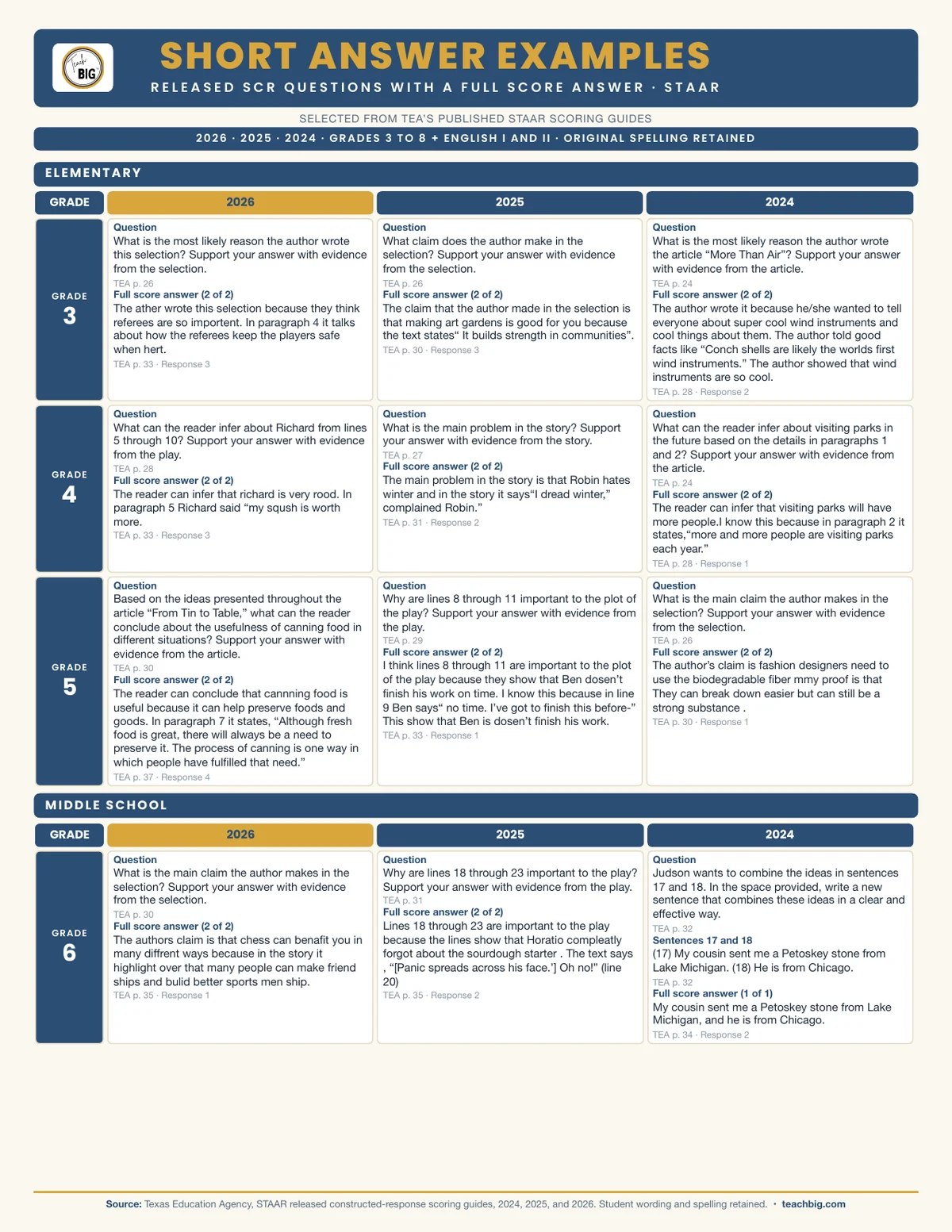
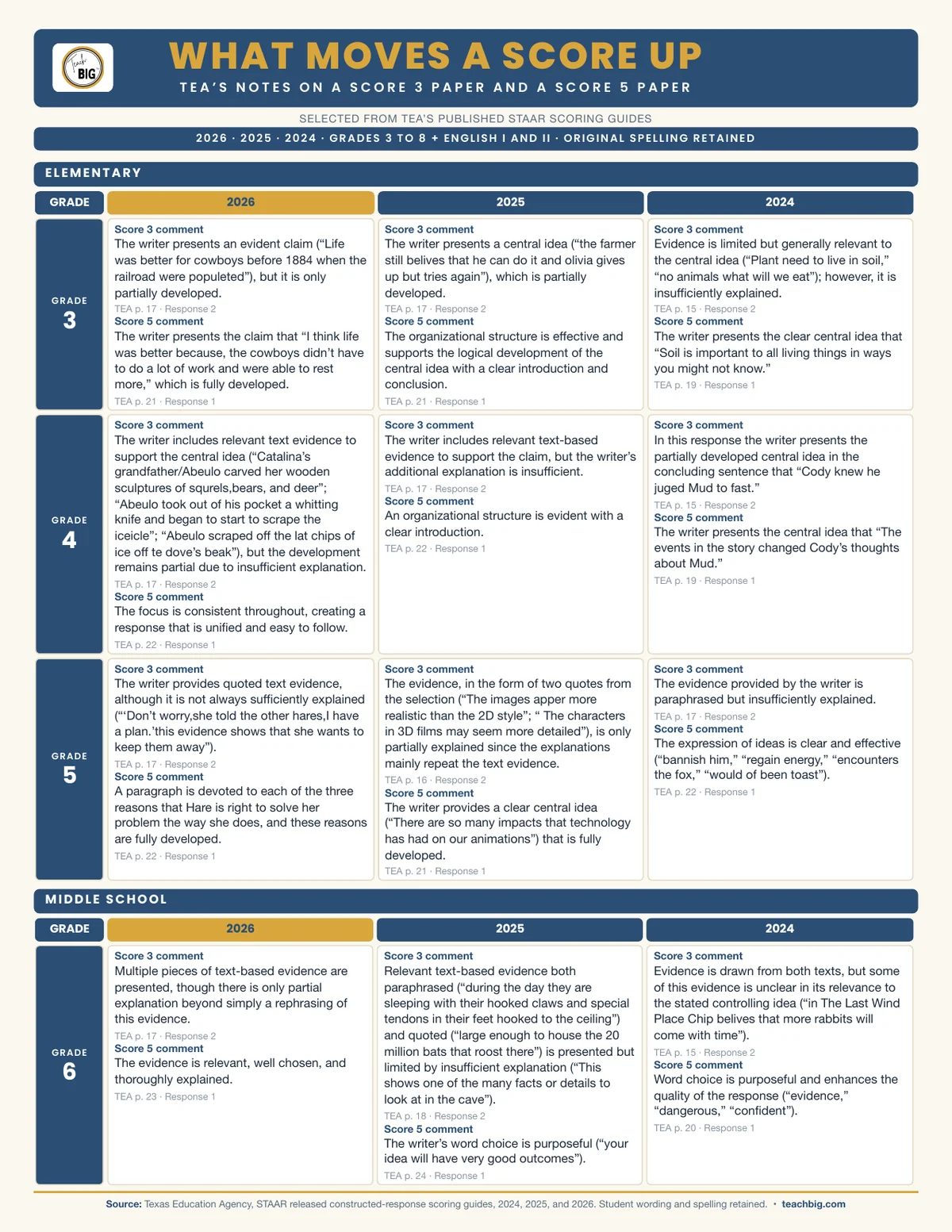
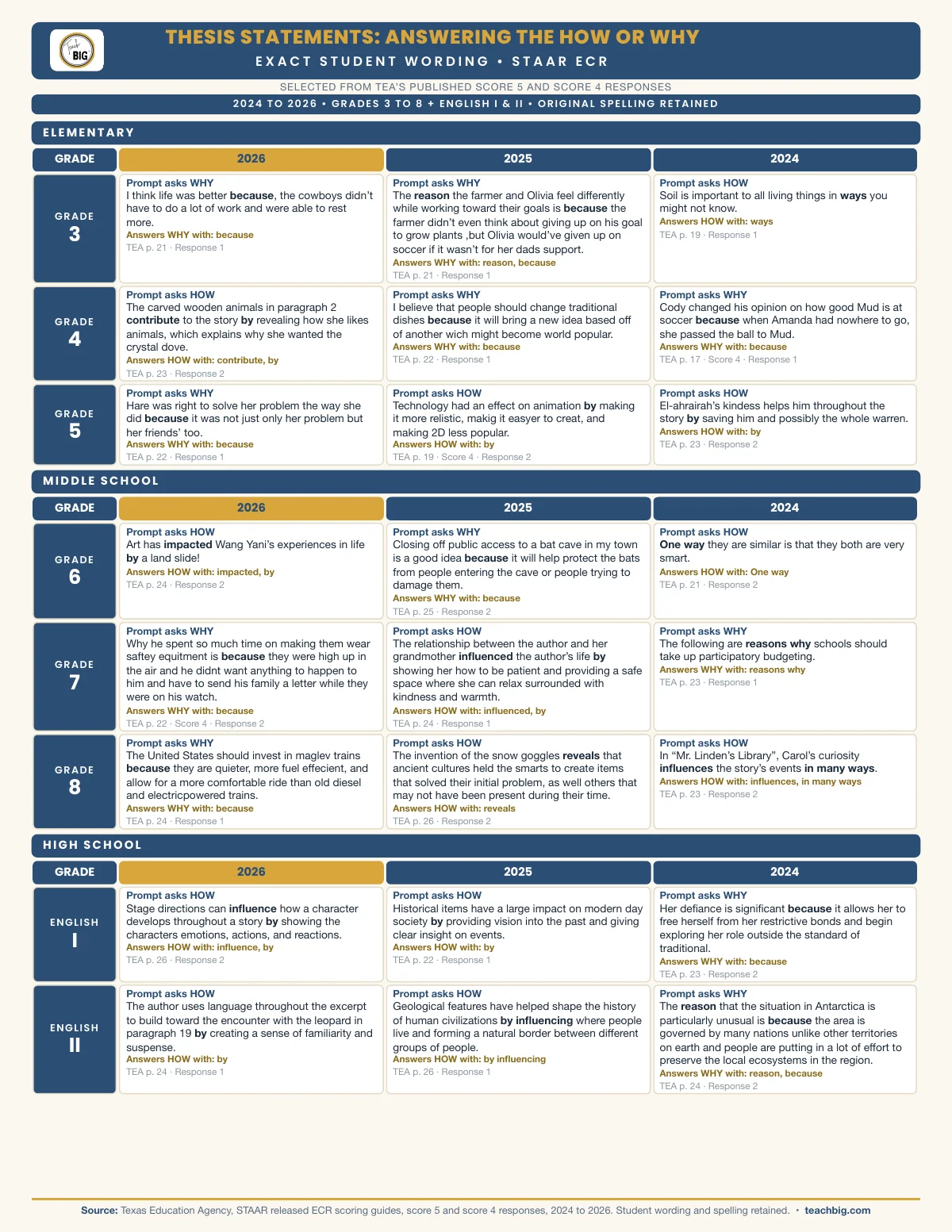
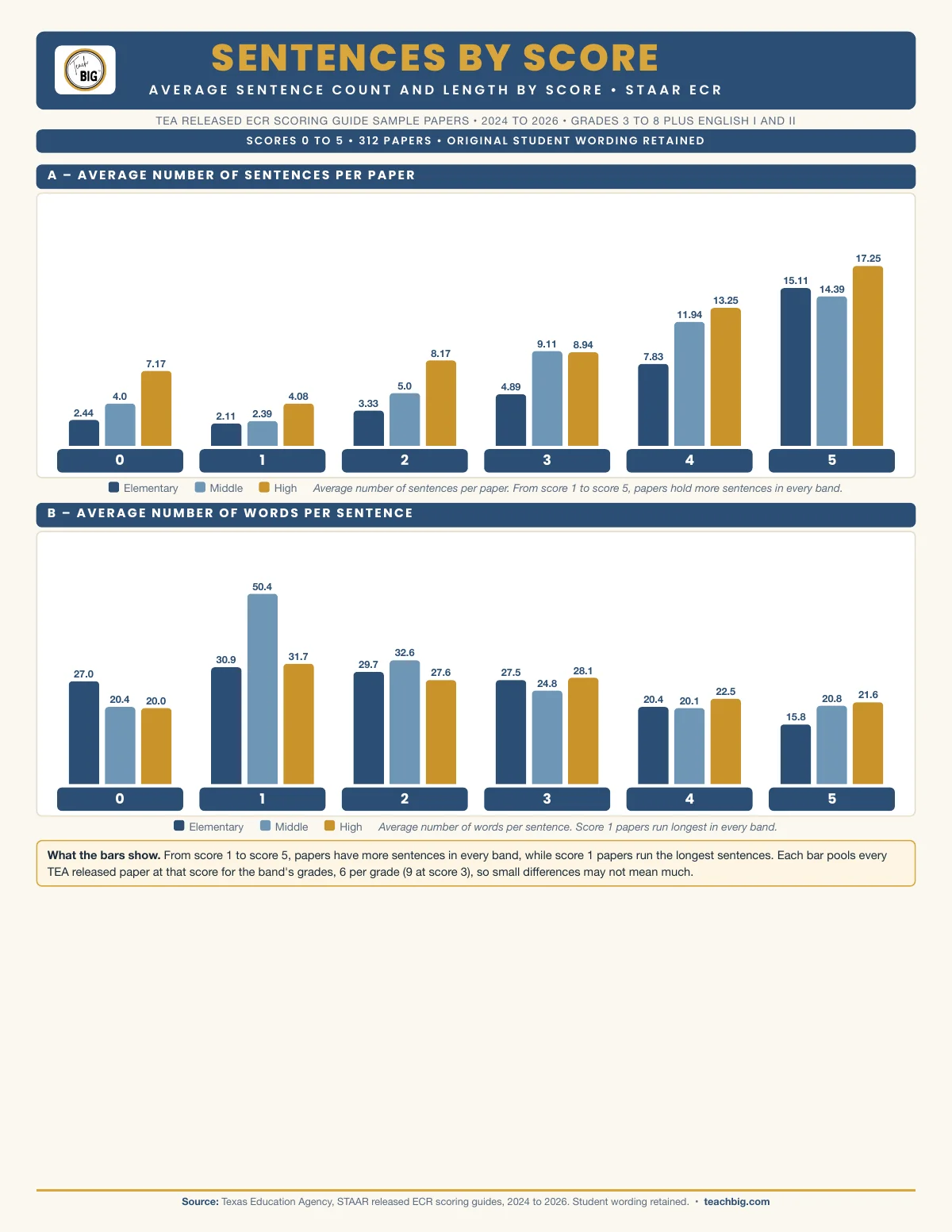
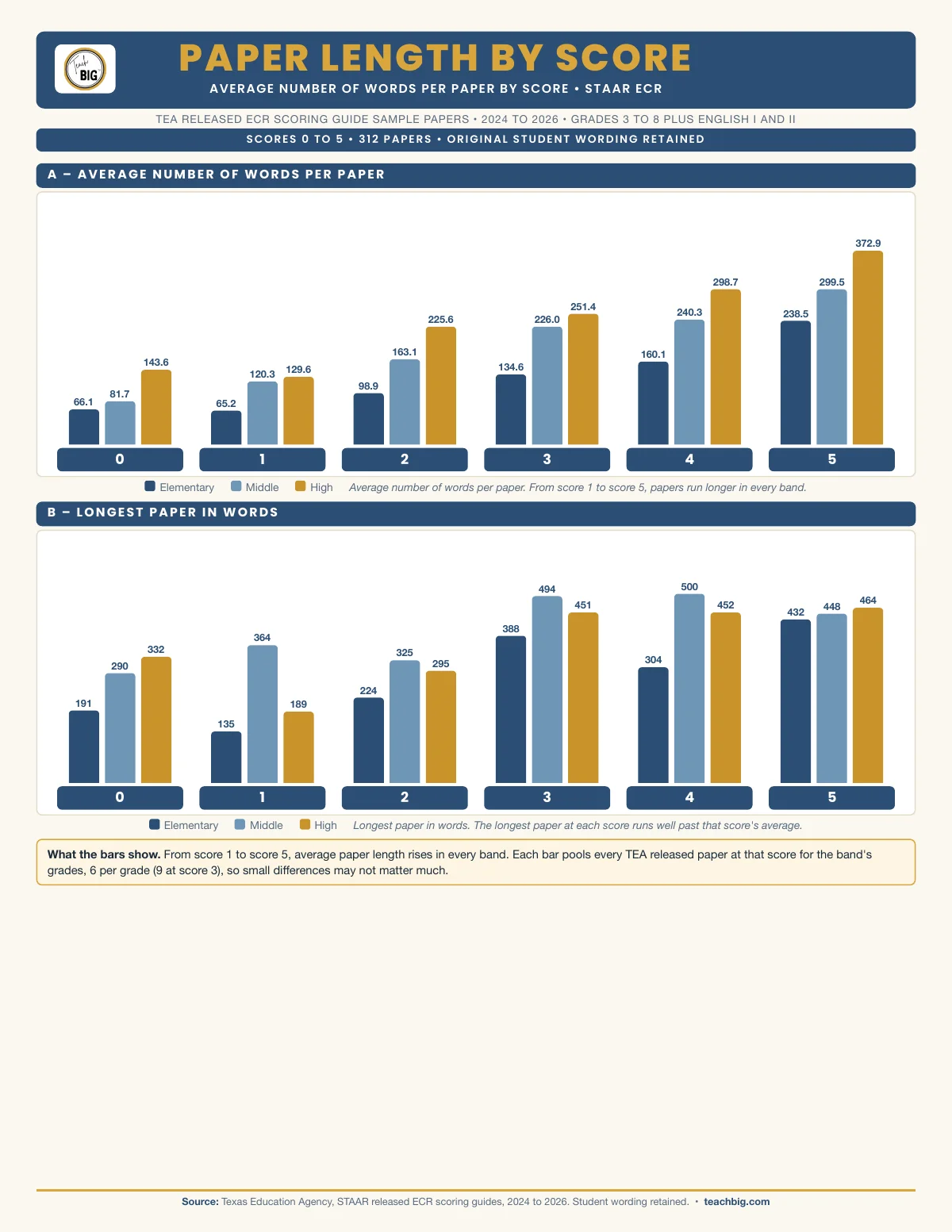
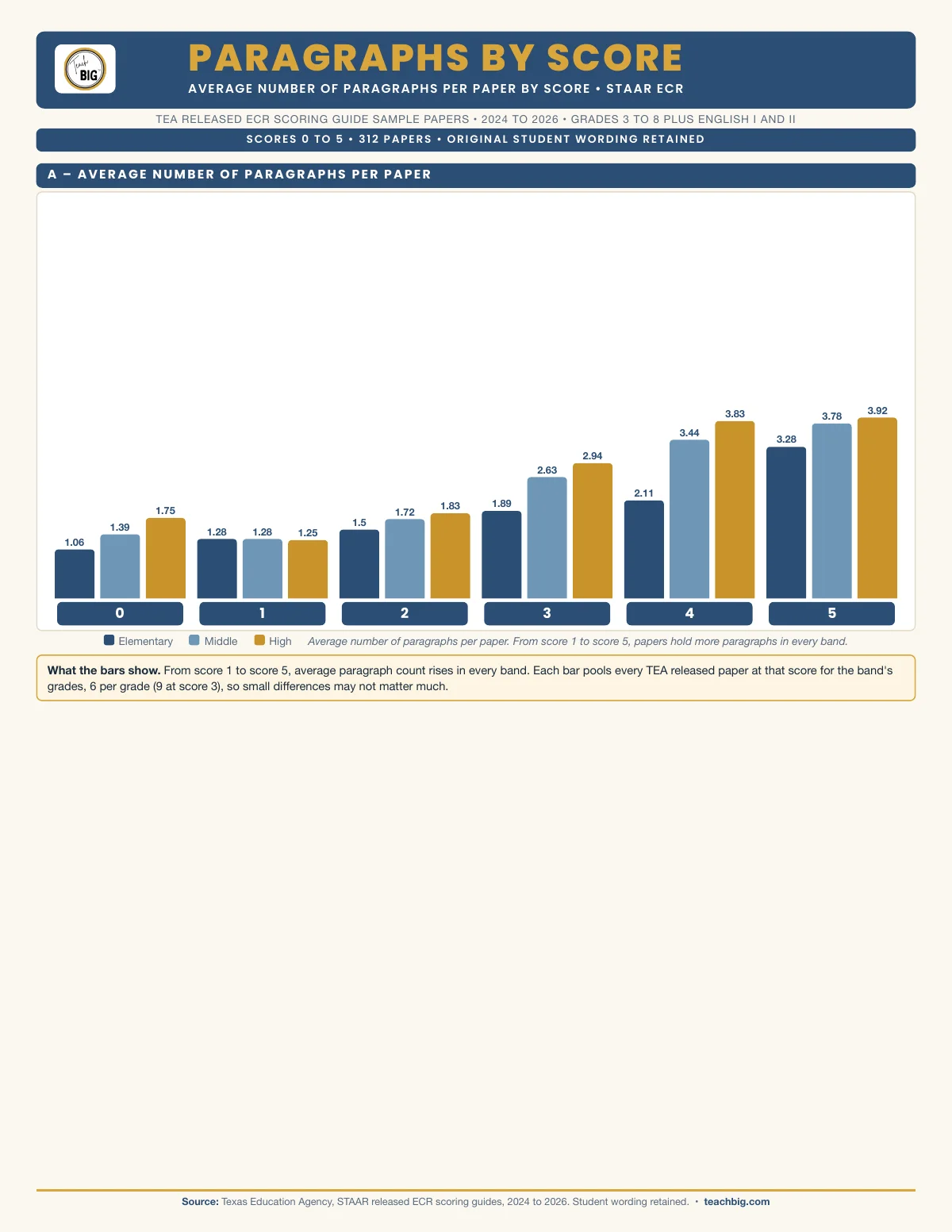
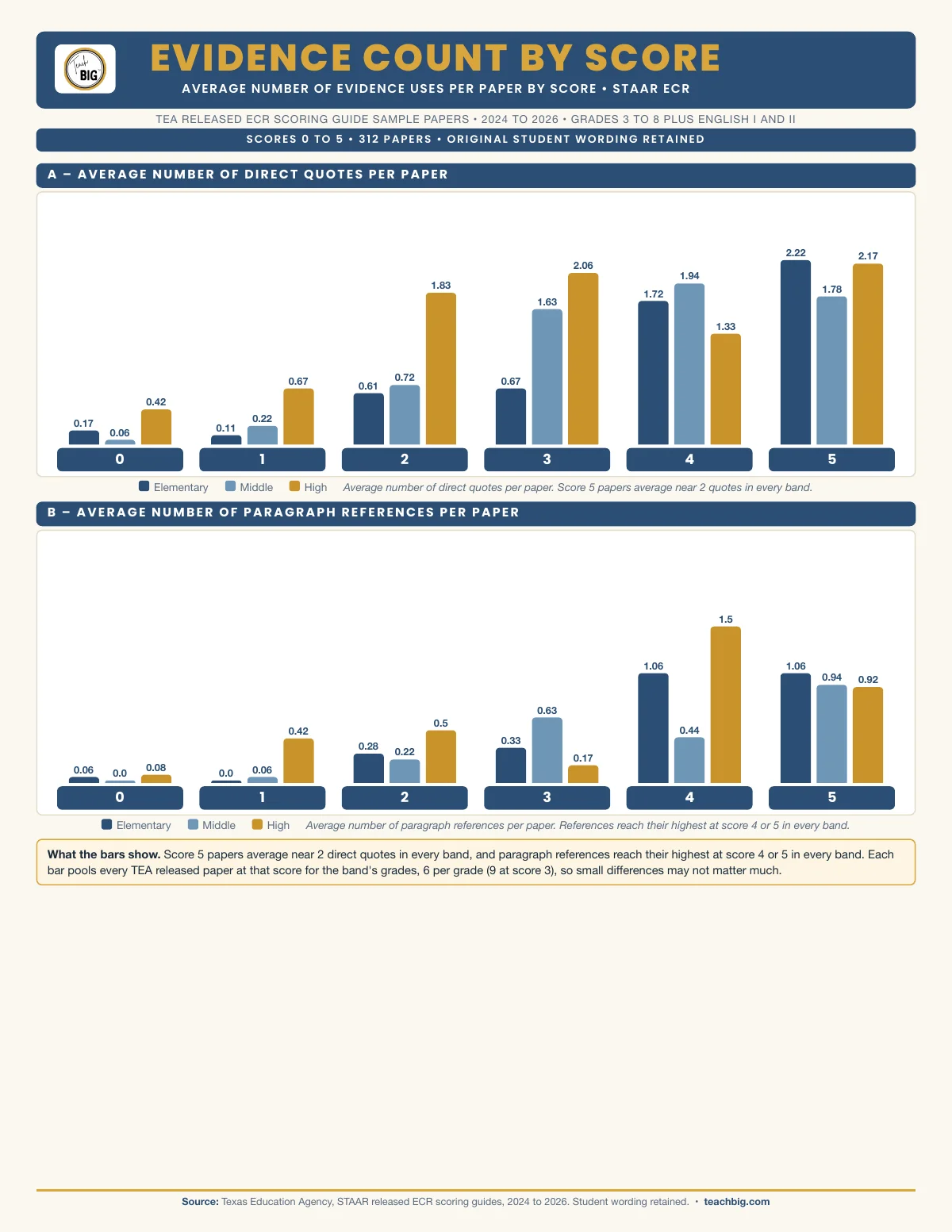
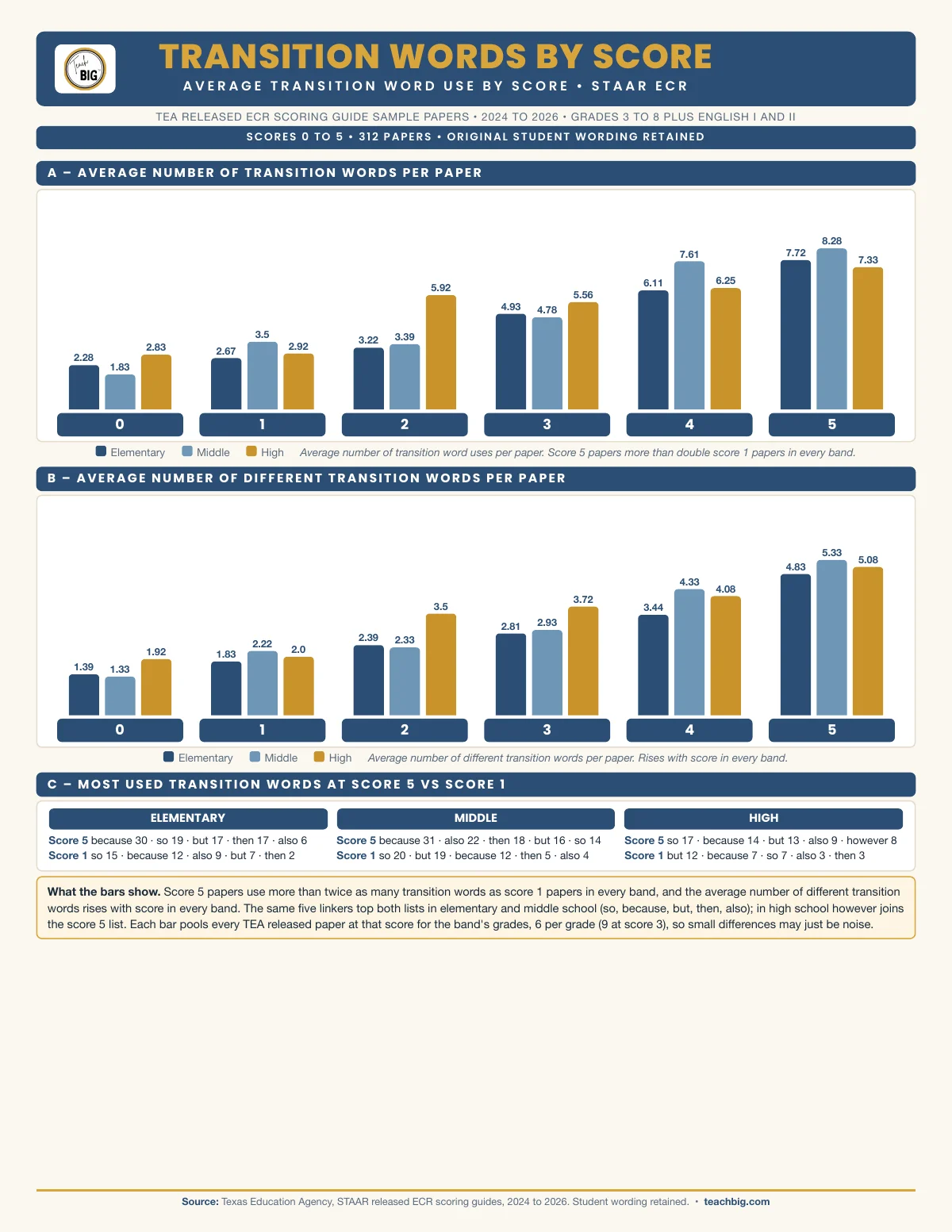
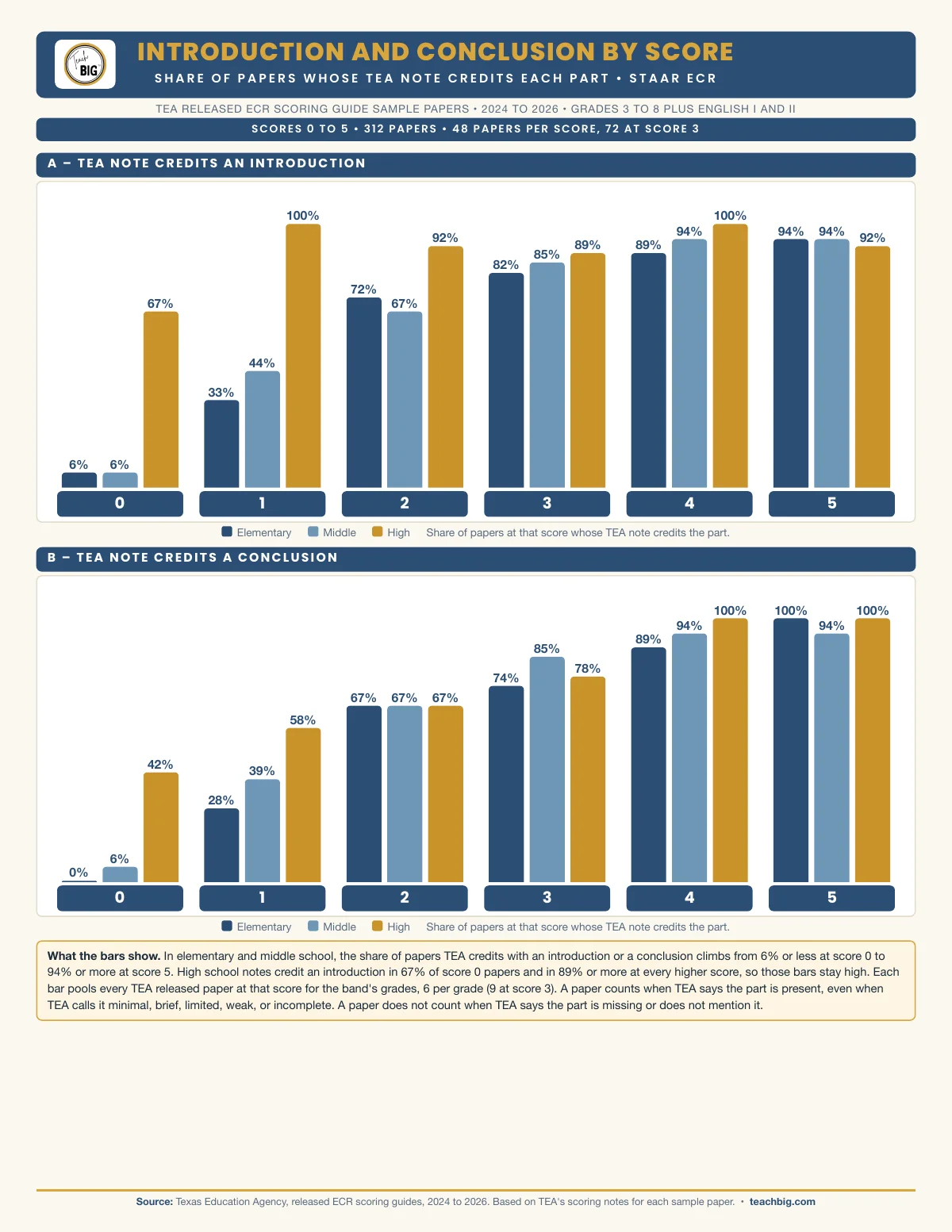
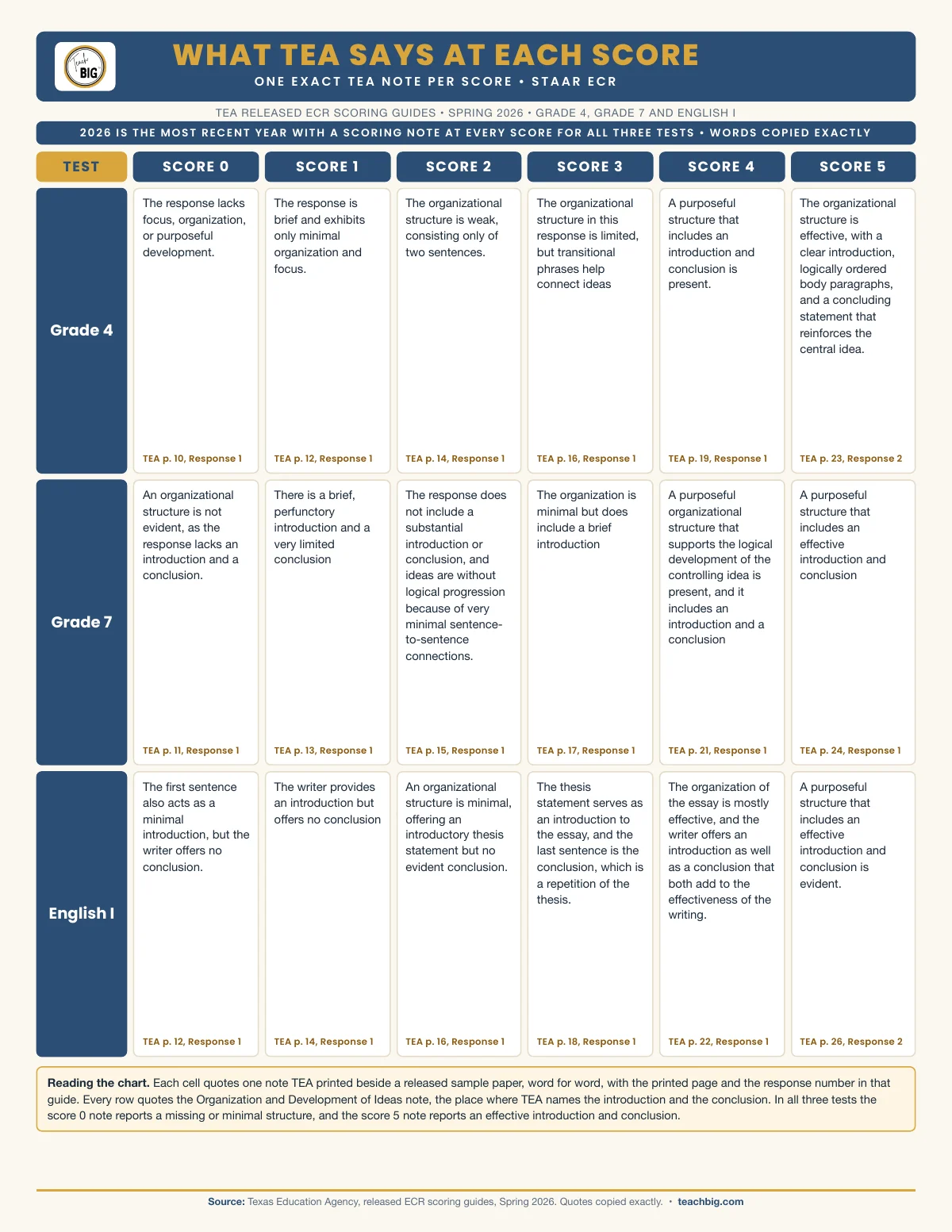
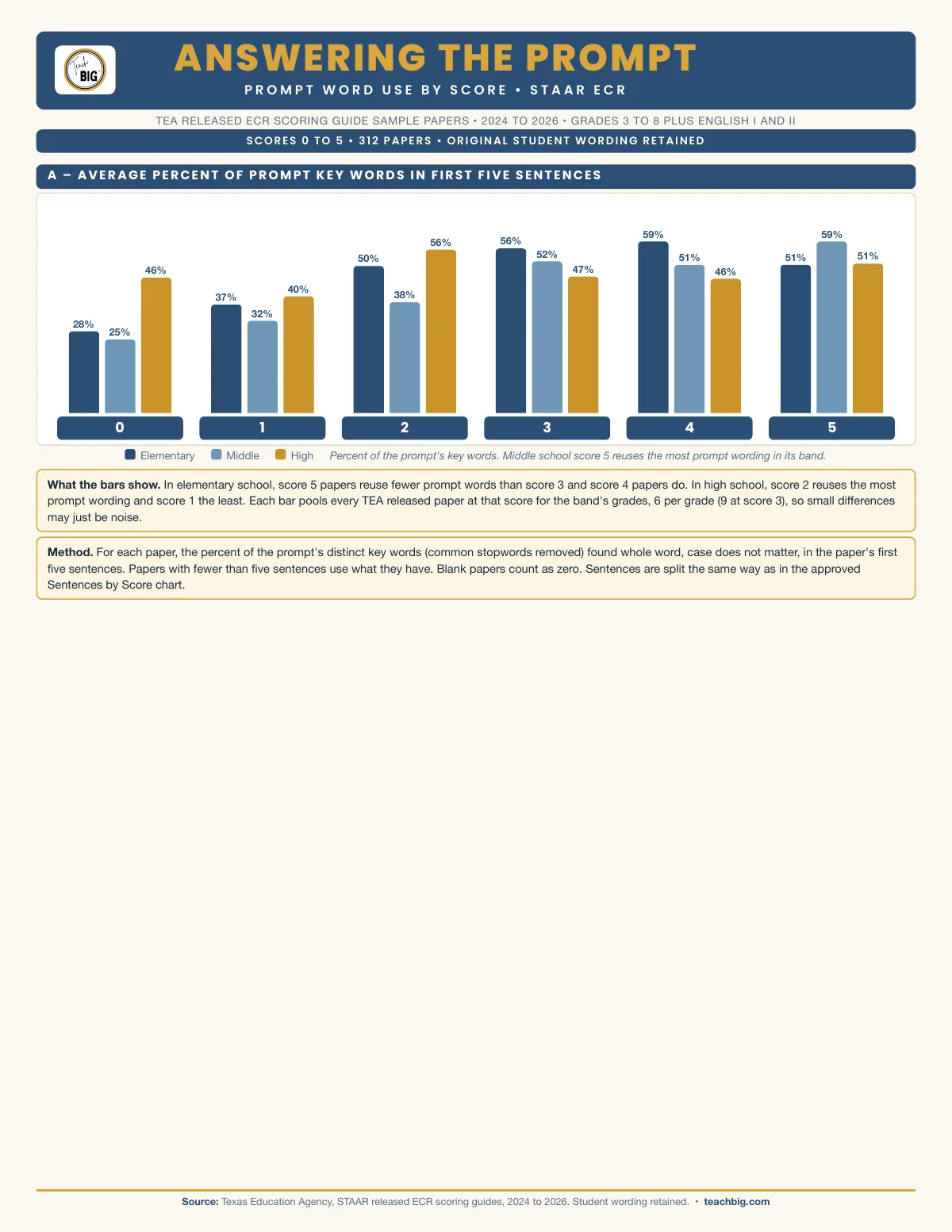
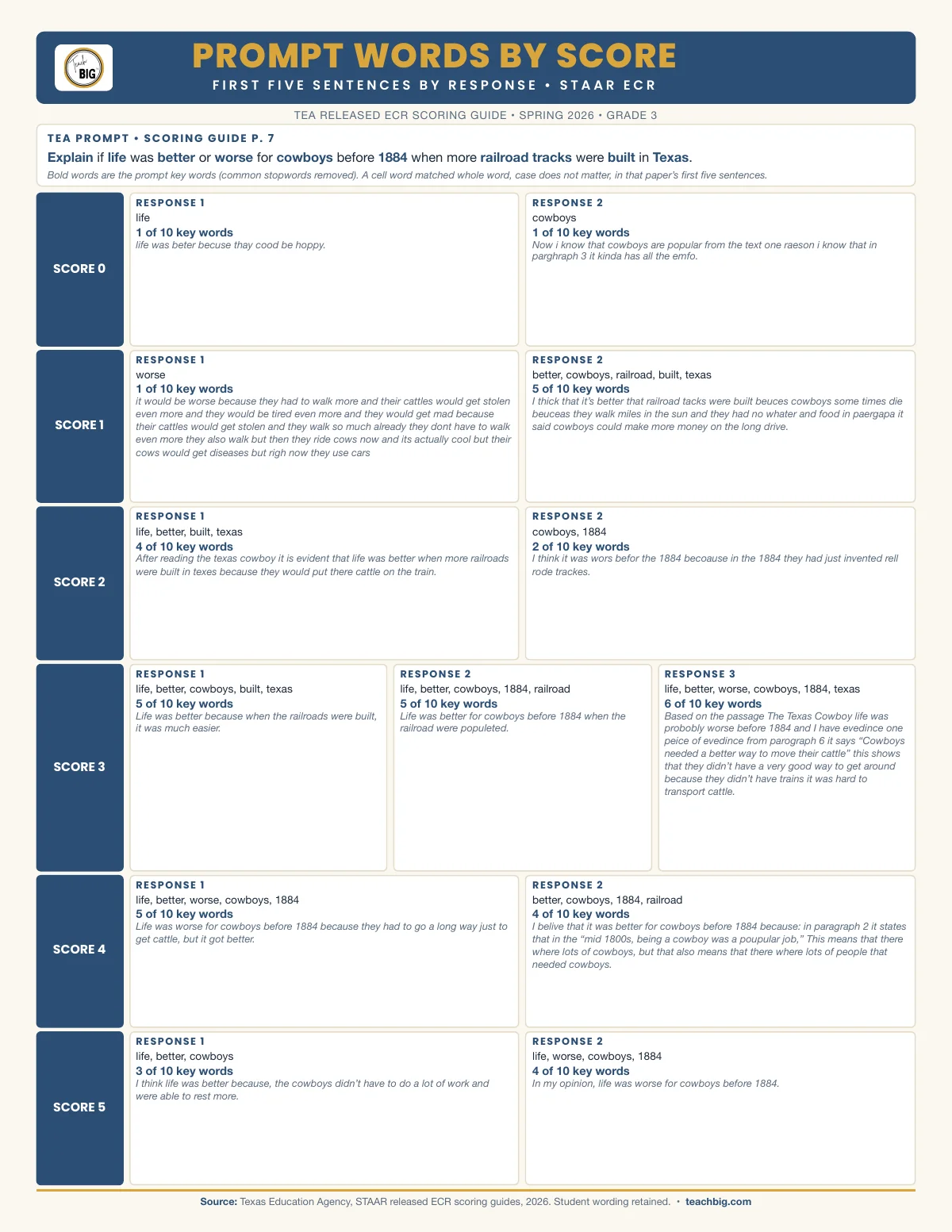
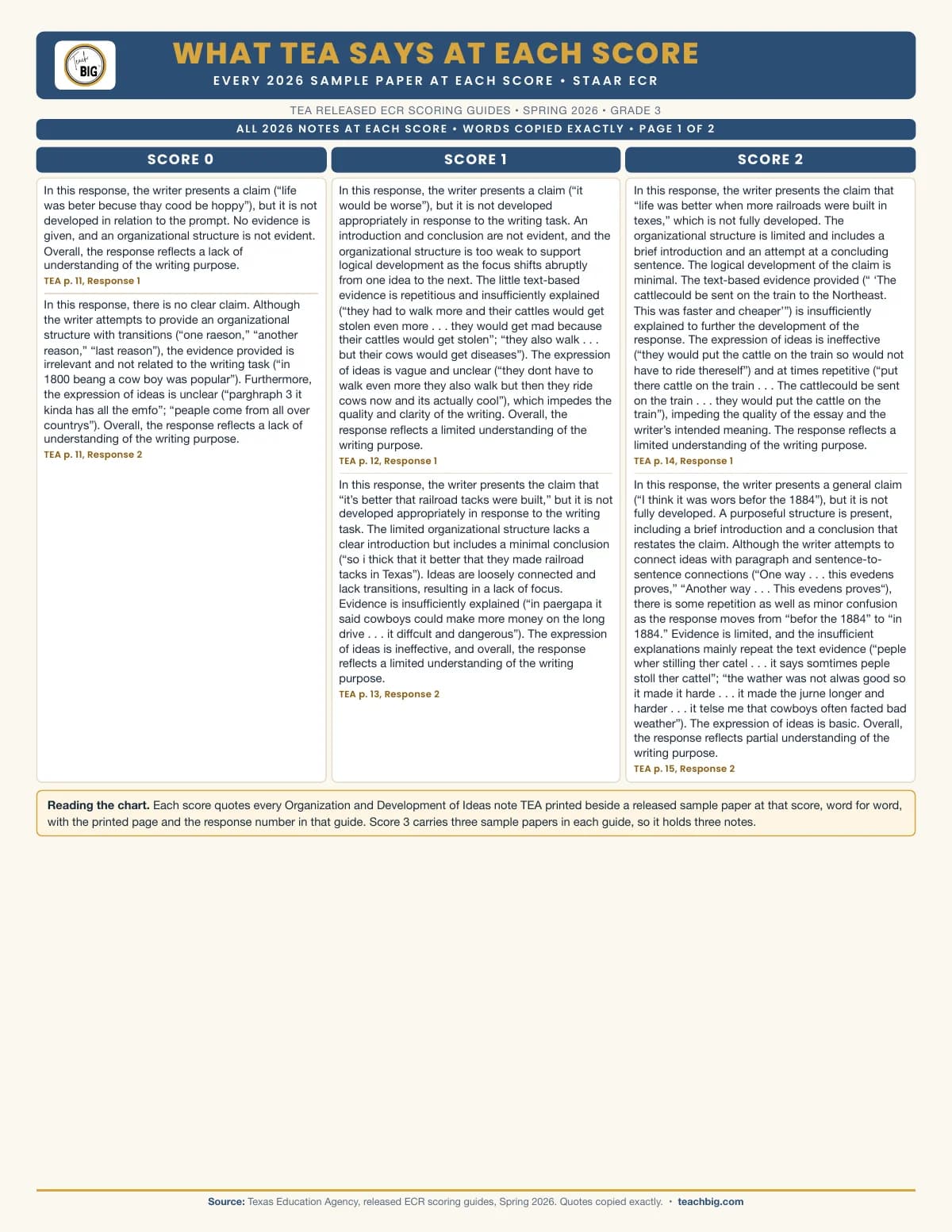
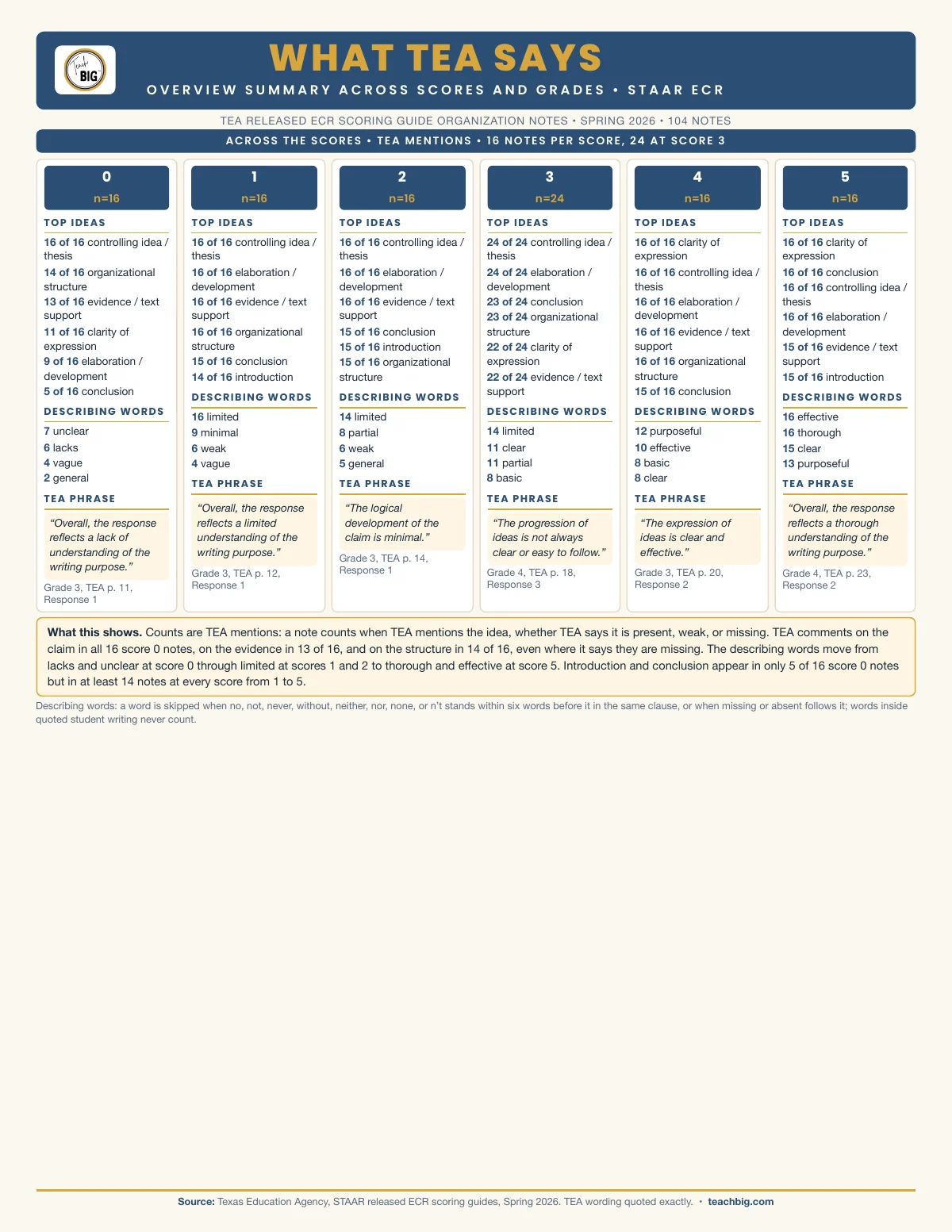
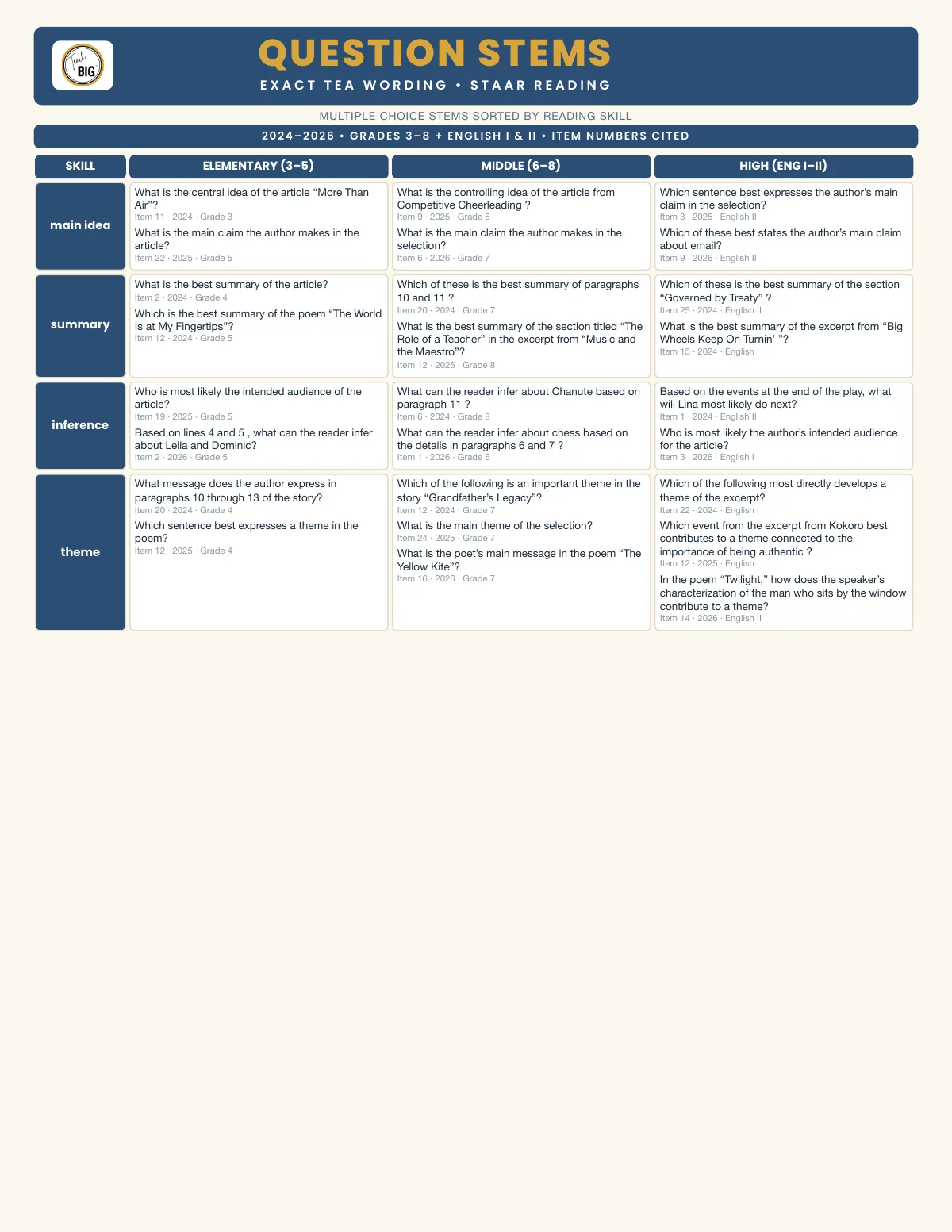
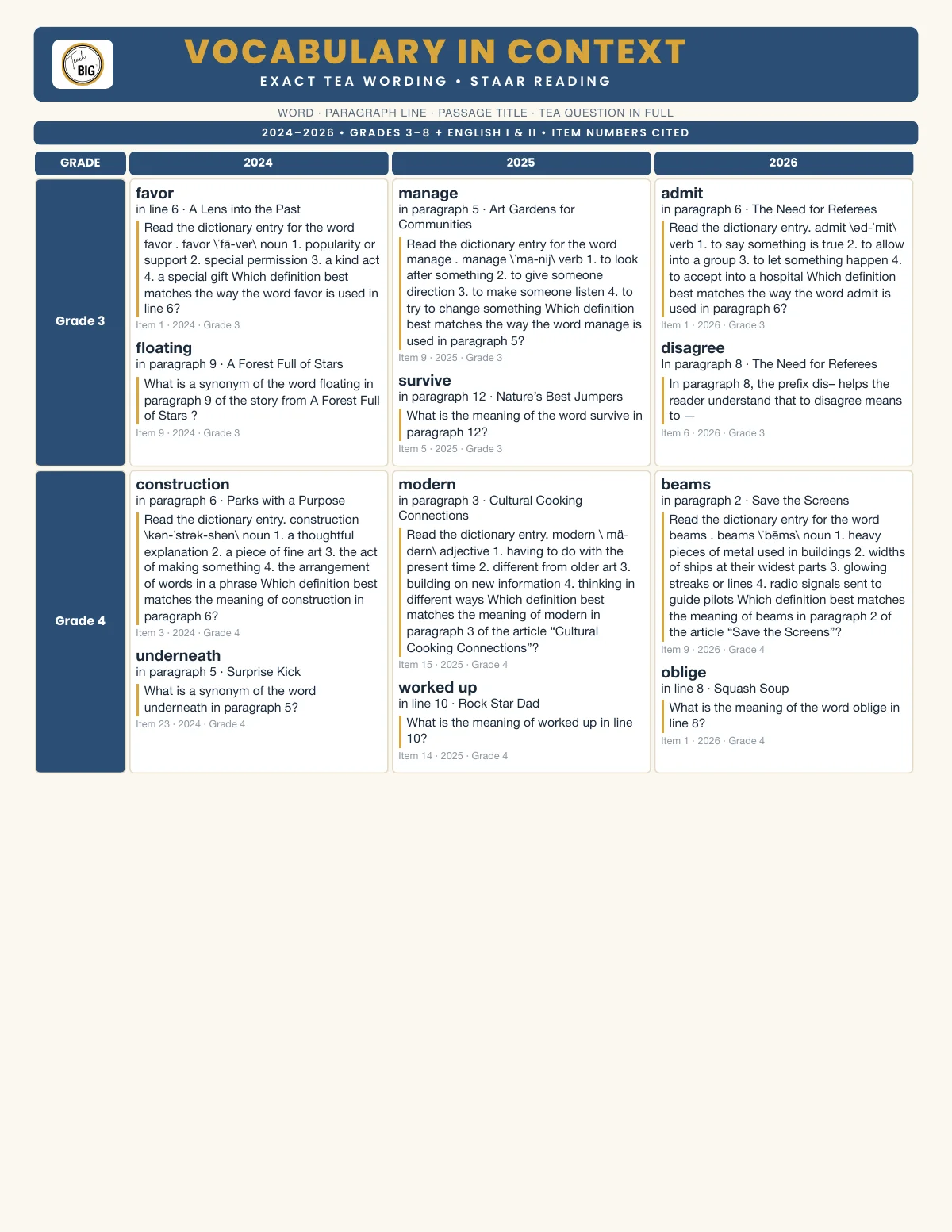
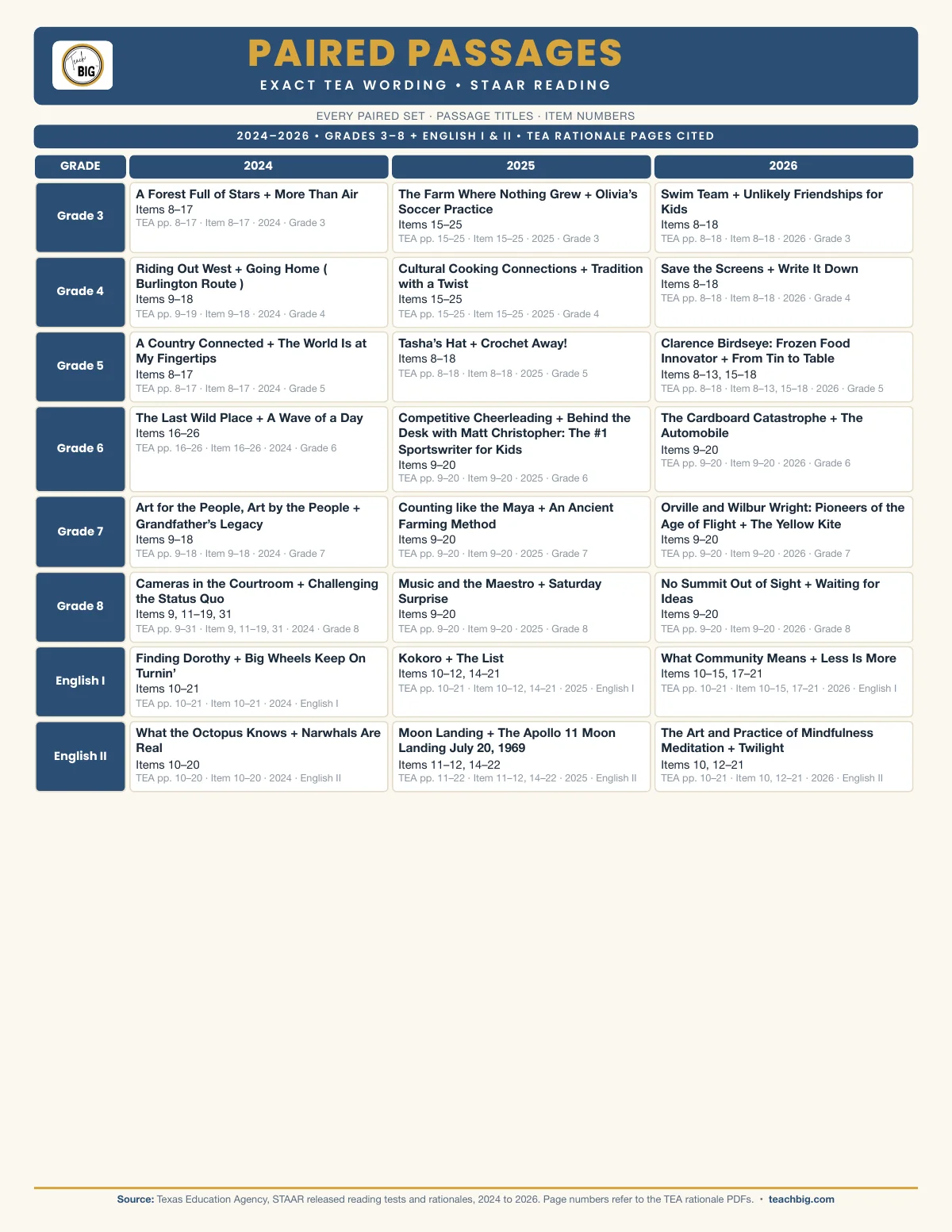
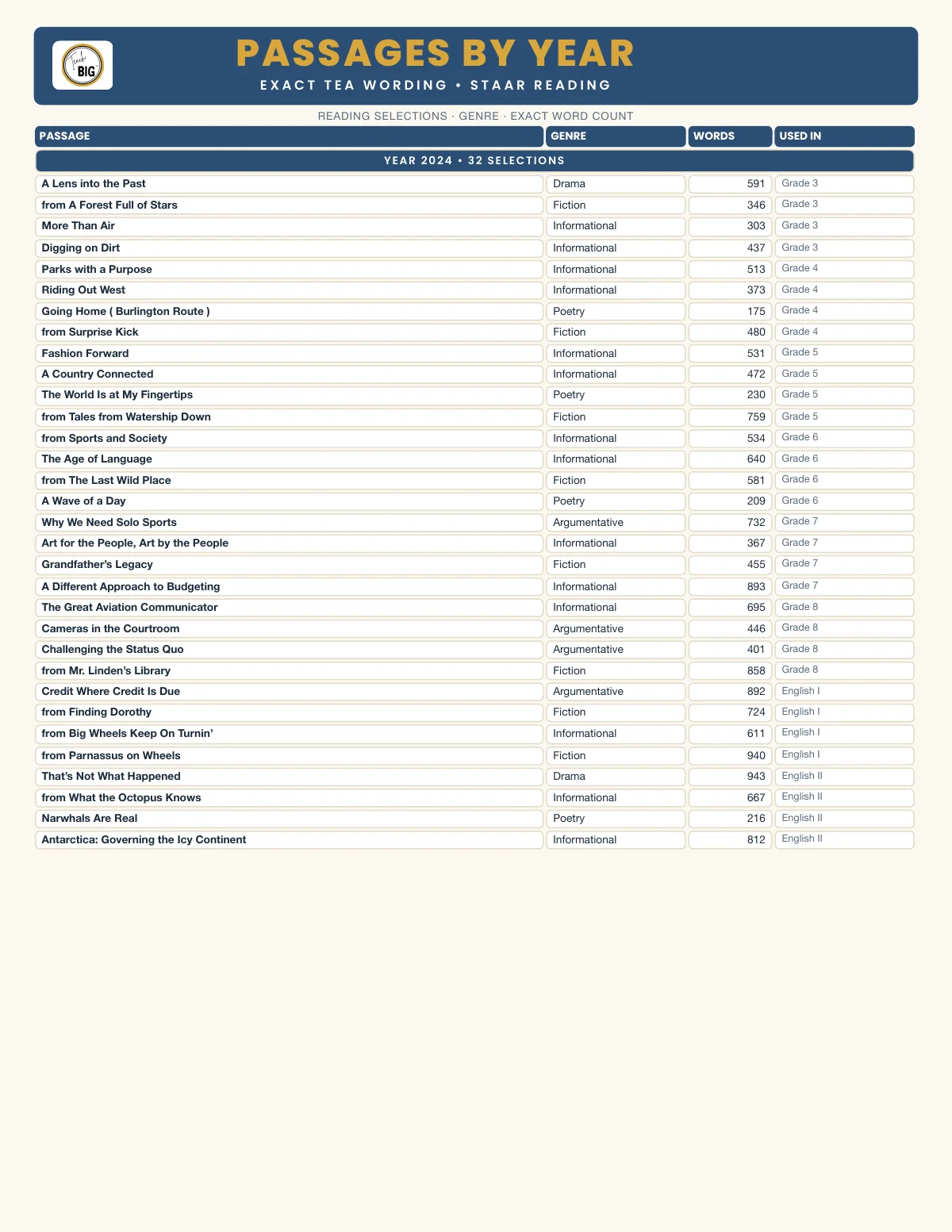
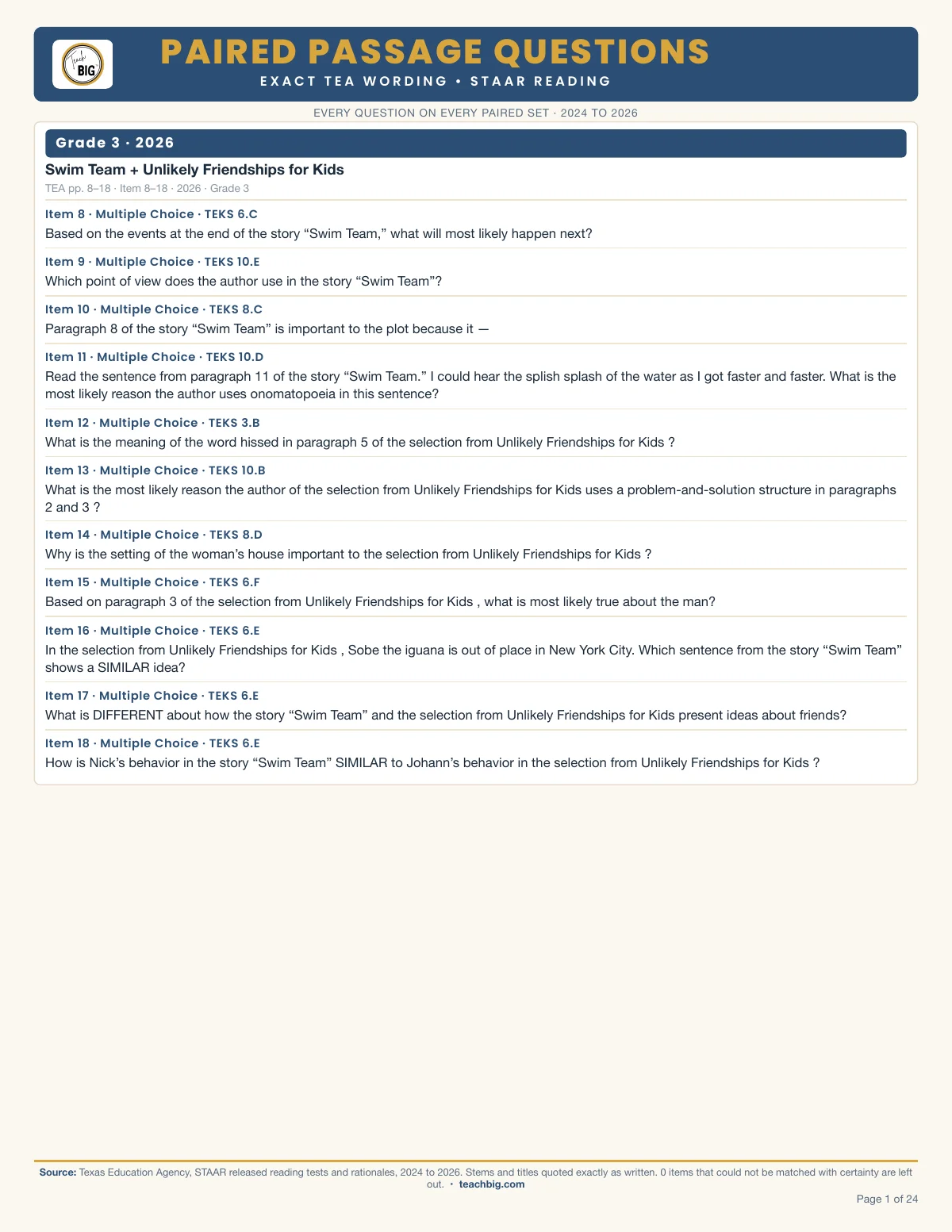
Print a chart for your wall or hand it to students as a model. See the workshops
I know the TEA website has so much information on it. This section points out the important things. Enjoy clicking below.
Statewide release including RLA, mathematics, science, and grade 8 social studies.
Algebra I, Biology, English I, English II, and U.S. History performance summary.
Historical meets and masters trends across grades 3 to 8 and EOC subjects.
Online test forms, answer keys, item rationales, and student expectations tested by grade.
Aggregate STAAR data by state, region, district, or campus (access linked from TEA grades 3 to 8 results release).
When a number surprises you, bring it to a seminar and we will connect it to the lessons that move that skill. See the workshops
See how the reading and writing TEKS connect to each other, strand by strand. Free to download and print.
Square social ready graphics on SST topics. Each image includes a TEA source line for sharing.
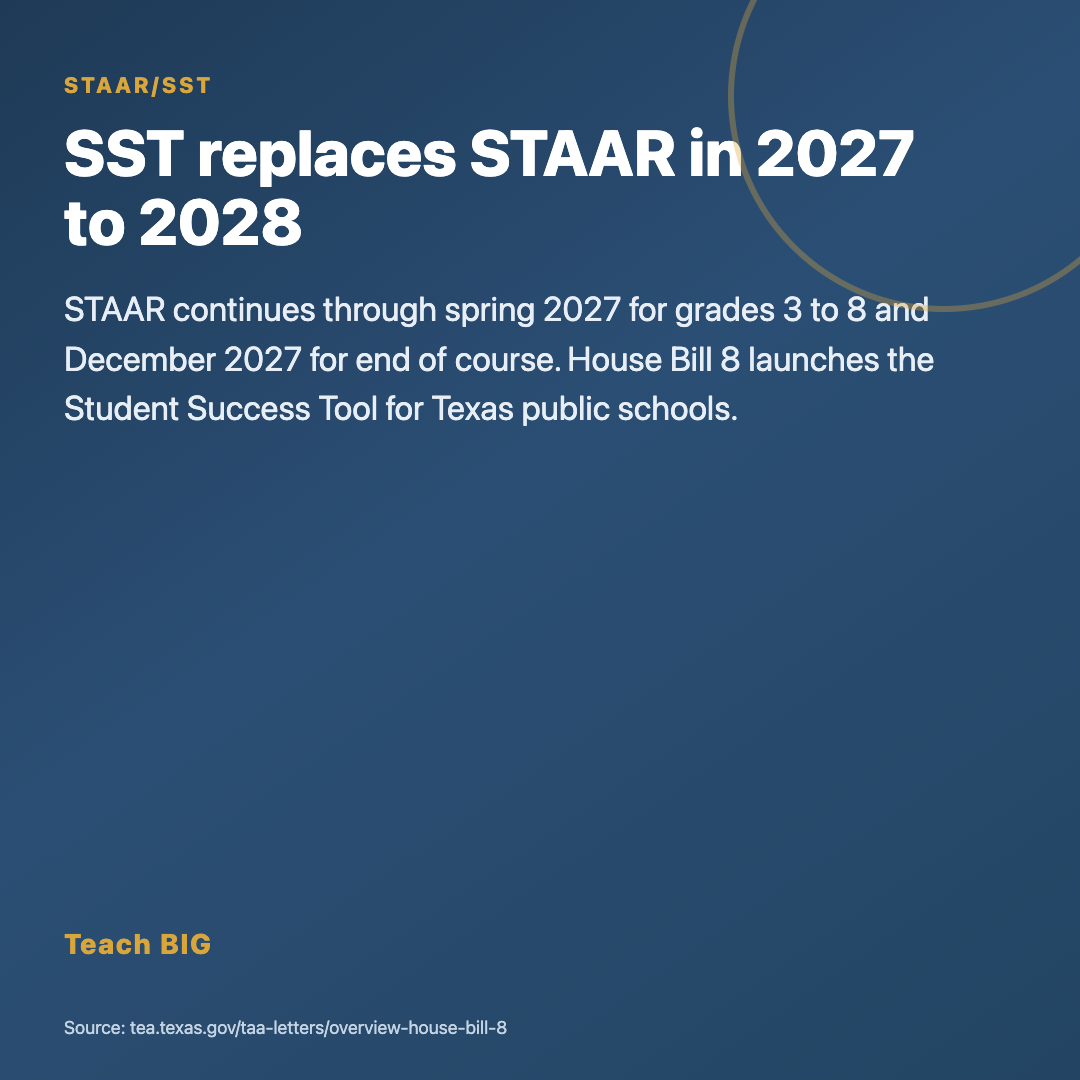
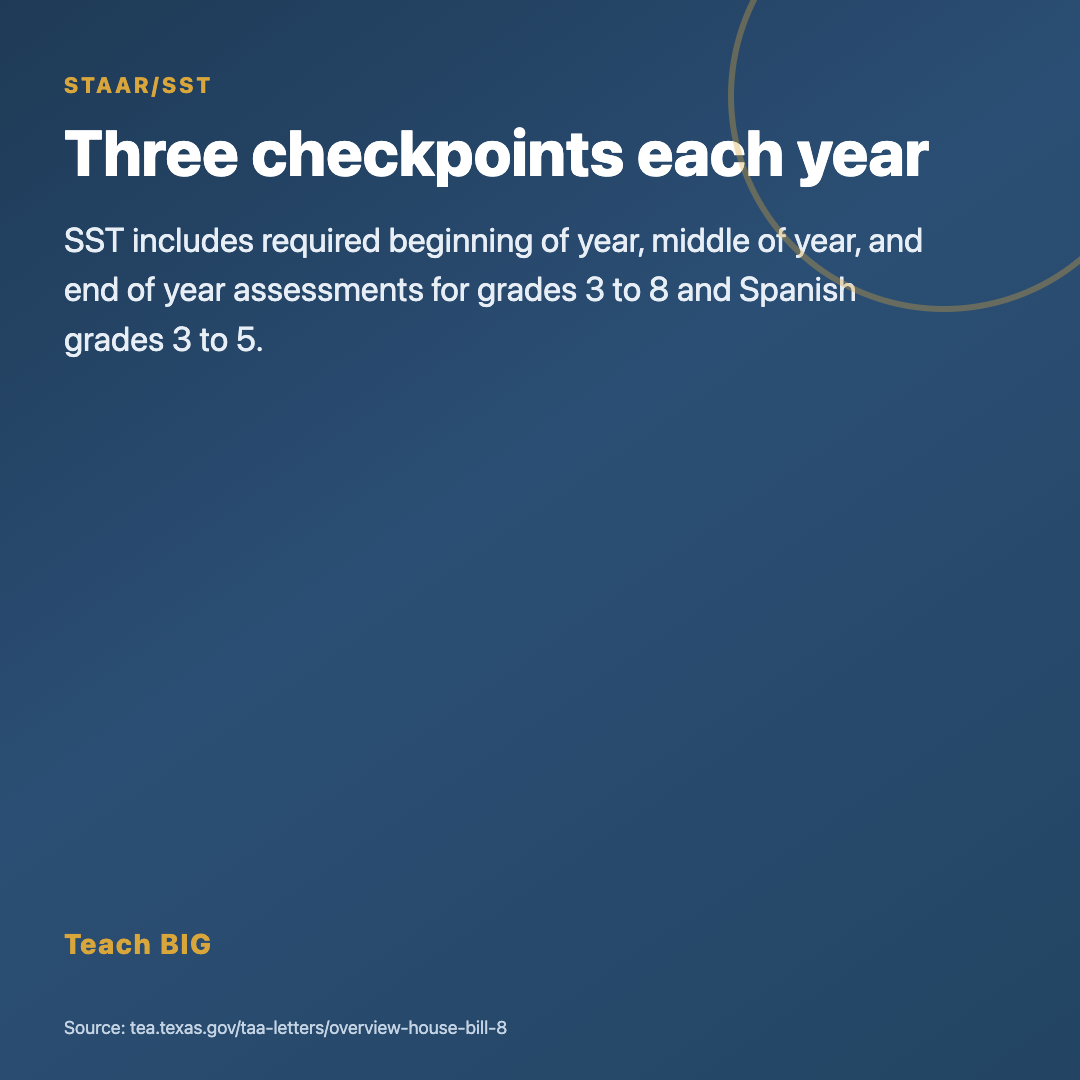
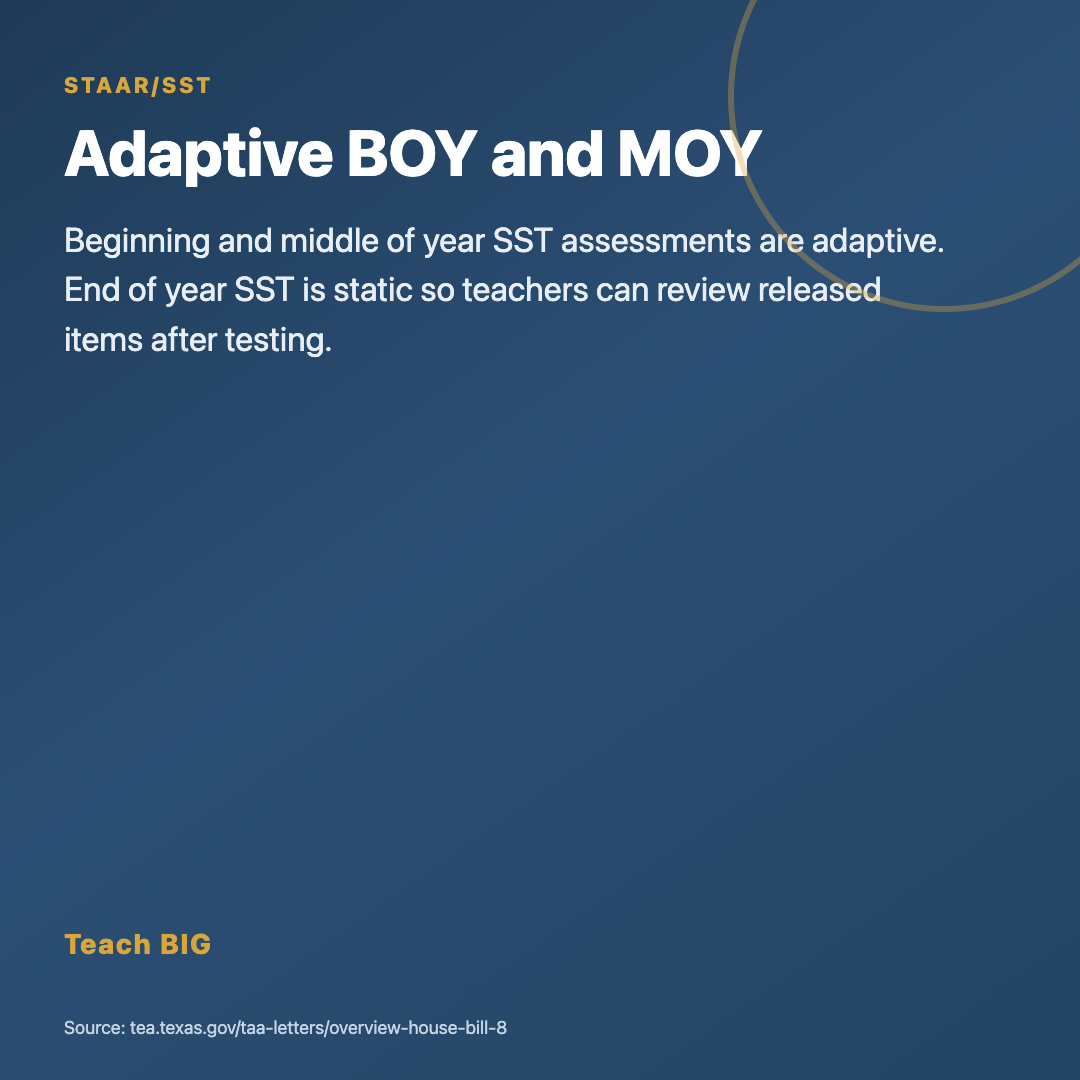
Each graphic opens on its own so you can read it or share it. Want the classroom version of these announcements? See the workshops

Pennington will answer all of your RLA questions!